
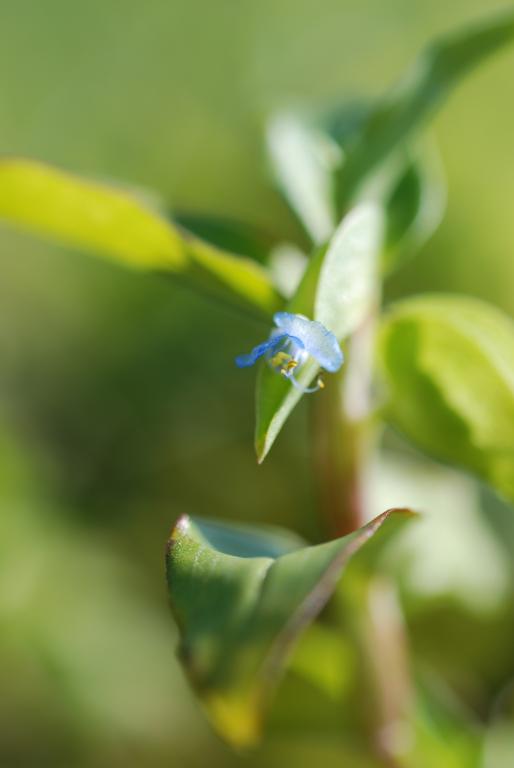
Spreading dayflower
Commelina diffusa
A succulent, creeping weed with parallel-veined leaves and small blue three-petaled flowers that roots at the nodes.
Identification
A trailing, mat-forming plant with succulent, jointed stems that root readily at the nodes, and smooth, lance-shaped, parallel-veined leaves with sheathing bases (it is a monocot, not a true broadleaf). Small, delicate flowers have two showy blue petals (and a reduced third), each lasting a day, emerging from a folded boat-shaped bract. The fleshy node-rooting stems and blue day-flowers are diagnostic.
Symptoms & Damage
Succulent, creeping, node-rooting plants with blue day-flowers form mats in moist, shaded turf and beds, crowding desirable grass.
Biology
Reproduces by seed and vegetatively from rooting stem fragments and nodes, behaving as a warm-season annual or short-lived perennial; broken pieces re-root readily, aiding spread by mowing and cultivation.
Occurrence & Spread
A weed of moist, shaded, warm-climate sites — irrigated turf, landscape beds, and low wet areas in the southern US; favored by moisture, shade, and open or thin turf.
Favorable Conditions
Moist, shaded, warm sites; thin turf.
Cultural Management
Improve drainage and reduce excess moisture and shade where possible; maintain a competitive stand. Because stem fragments re-root, remove whole plants when hand-weeding and avoid spreading pieces with mowers; mulch beds to suppress it.
Further Reading
University extension resources — open in a new tab.
Related Reports
No published reports yet for this pest.
Reports will appear here as they are peer-reviewed and published.