False green kyllinga
Kyllinga gracillima
A cold-hardy perennial mat-forming sedge, increasingly common in cool-season turf of the mid-Atlantic and Northeast.
Identification
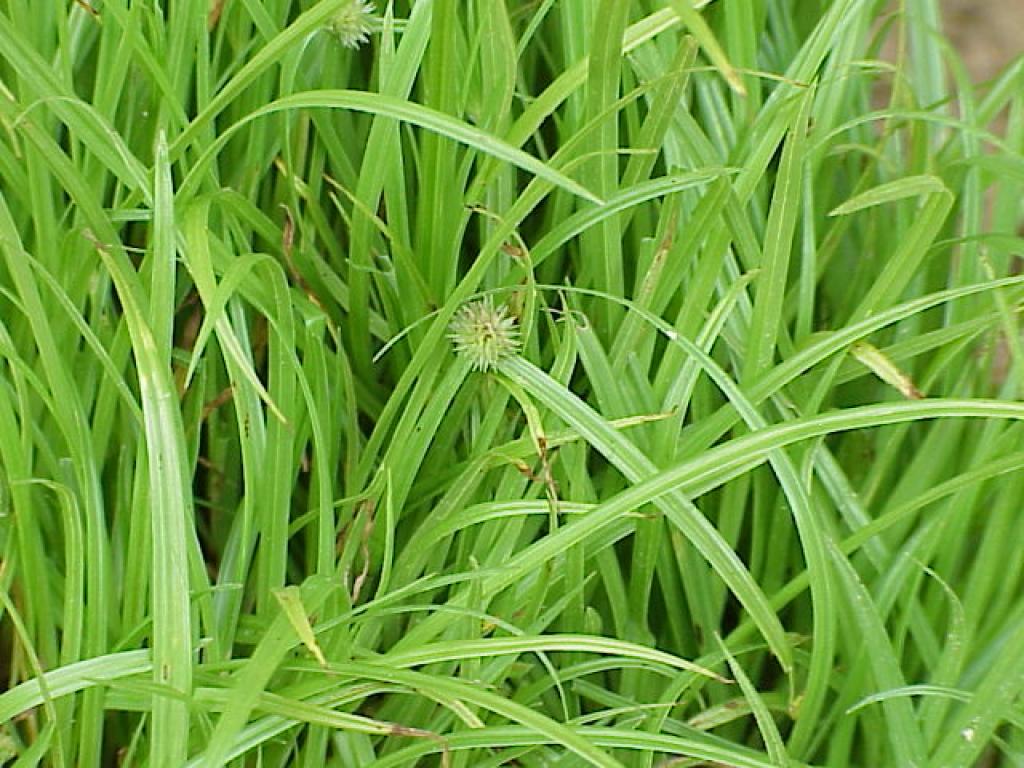
False green kyllinga (Kyllinga gracillima) is a low, mat-forming perennial sedge nearly identical in appearance to green kyllinga: narrow, glossy, grass-like leaves, triangular stems ("sedges have edges"), and a single round to oval green seedhead subtended by three leaf-like bracts held just above the foliage. It is the cold-hardy species of the pair — where a dense, dark-green kyllinga mat persists year after year in cool-season turf (mid-Atlantic, Northeast, transition zone), false green kyllinga is the likely species. Reliable separation from green kyllinga (K. brevifolia) requires close inspection of spikelet characters, but management for the two is the same. Distinguished from nutsedges by its much lower, mat-forming habit and green (not yellow or purple) seedheads.
Symptoms & Damage
Forms dense, dark-green, low-growing mats that stand out in color and texture from the surrounding turf, especially in damp areas. Tolerates close mowing better than most cool-season grasses, so mats persist on collars, approaches, fairways, and lawns, studded with round green seedheads in summer. Patches expand steadily by rhizomes, thinning and displacing desirable turf, and the mats remain conspicuous straw-brown after frost.
Biology
A perennial sedge spreading aggressively by rhizomes and by seed from the round summer seedheads. Rhizomes let it regenerate after mowing or hand-pulling and expand mats outward each season. Unlike green kyllinga, it reliably overwinters in cold climates — top growth browns off after frost, but the rhizome network resumes growth in late spring, which is why infestations in Pennsylvania, New Jersey, and similar climates return year after year.
Occurrence & Spread
Most active in warm weather, emerging later in spring than cool-season turf and browning after frost. Thrives in chronically wet, poorly drained, or over-irrigated sites and under close mowing, which give it a competitive edge. First confirmed widely in the mid-Atlantic in the 1990s and has spread through cool-season turf regions since; drainage swales, low damp areas, and irrigated close-cut turf are typical entry points.
Favorable Conditions
Wet, poorly drained, or over-irrigated turf; tolerates close mowing; cold-hardier than green kyllinga, persisting in cool-season regions.
Cultural Management
Correct the moisture advantage first: improve drainage and reduce over-irrigation. Raise mowing height where feasible and maintain dense, vigorous turf to reduce its competitiveness. Small, well-defined mats can be removed with a sod cutter deep enough to lift the rhizome layer — any rhizome fragments left behind can regenerate the colony.
Further Reading
University extension resources — open in a new tab.
Related Reports
No published reports yet for this pest.
Reports will appear here as they are peer-reviewed and published.