
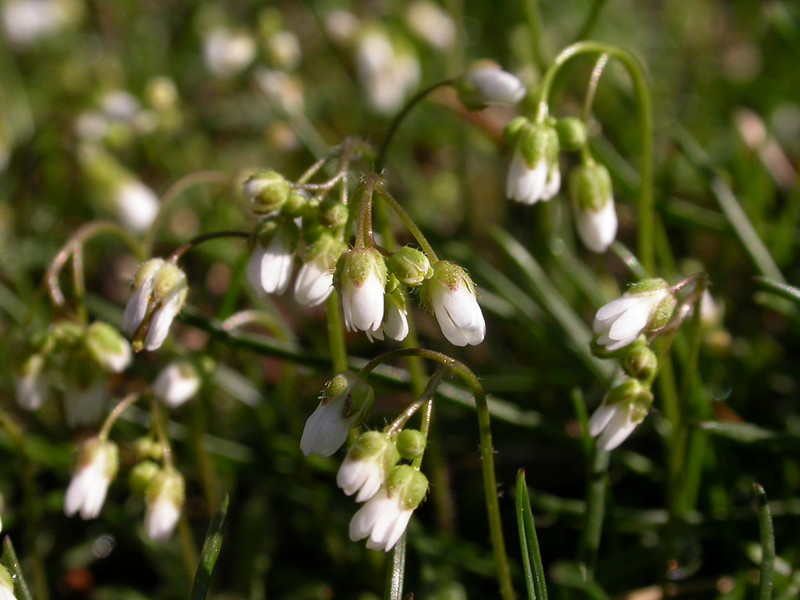
Spring whitlowgrass
Draba verna
A tiny winter-annual mustard forming ground rosettes with thin stalks of small white flowers in very early spring.
Identification
Spring whitlowgrass (Draba verna, formerly Erophila verna) is a very small winter-annual broadleaf in the mustard family. It grows as a low basal rosette of tiny, oblong to spatula-shaped grayish-green leaves that are hairy and pressed close to the soil, rarely more than an inch or two across. In very early spring it sends up slender, leafless flower stalks two to six inches tall bearing small white flowers; each flower has four petals so deeply notched that they appear as eight, a key diagnostic trait. Flowering is quickly followed by flat, oval to elliptical seedpods (silicles) held on thin pedicels. The minute stature, ground-hugging hairy rosette, leafless stalks, and deeply cleft white petals separate it from other early cool-season weeds such as hairy bittercress and the chickweeds.
Symptoms & Damage
Spring whitlowgrass appears as scattered tiny rosettes and thin, wiry flower stalks dotting thin or dormant turf in late winter and very early spring, giving weak or bare areas a fine, hazy speckling of small white flowers. It is a minor competitor because plants are small and short-lived, but heavy stands highlight thin, open, or drought-prone turf and can reseed prolifically into those same weak areas year after year.
Biology
Spring whitlowgrass is a winter annual reproducing only by seed. Seeds germinate in fall, plants overwinter as small ground rosettes, then bolt, flower, and set seed extremely early in spring before dying out as temperatures rise in late spring. Its short, fast life cycle lets it flower and replenish the seedbank before most other weeds are active, and abundant early seed production sustains the next fall's germination flush.
Occurrence & Spread
It colonizes thin, open, dry turf and disturbed or gravelly ground where fall sunlight and surface moisture reach bare soil. Sparse, drought-stressed, sandy, or low-maintenance stands, path edges, and compacted areas are typical entry points. As with other winter annuals, an open canopy going into fall combined with adequate soil-surface moisture during the germination window sets the stage for establishment.
Favorable Conditions
Thin, dry, sandy or gravelly turf; open ground exposed in fall.
Cultural Management
Maintaining dense, vigorous cool-season turf is the most effective control: select adapted cultivars and fertilize, mow, and water to keep a thick canopy that shades the soil and denies the tiny seedlings the light and open ground they need. Repair and overseed thin, dry, or sandy areas before the fall germination window, relieve compaction, and hand-remove or spot-treat small patches before the early flowers set seed, since the plant reseeds heavily into the same weak spots.
Further Reading
University extension resources — open in a new tab.
Related Reports
No published reports yet for this pest.
Reports will appear here as they are peer-reviewed and published.