
Tall fescue (as a weed)
Schedonorus arundinaceus
A desirable turf in its own right, but coarse-bladed clumps are a weed in fine-textured bluegrass/bentgrass stands.
Identification
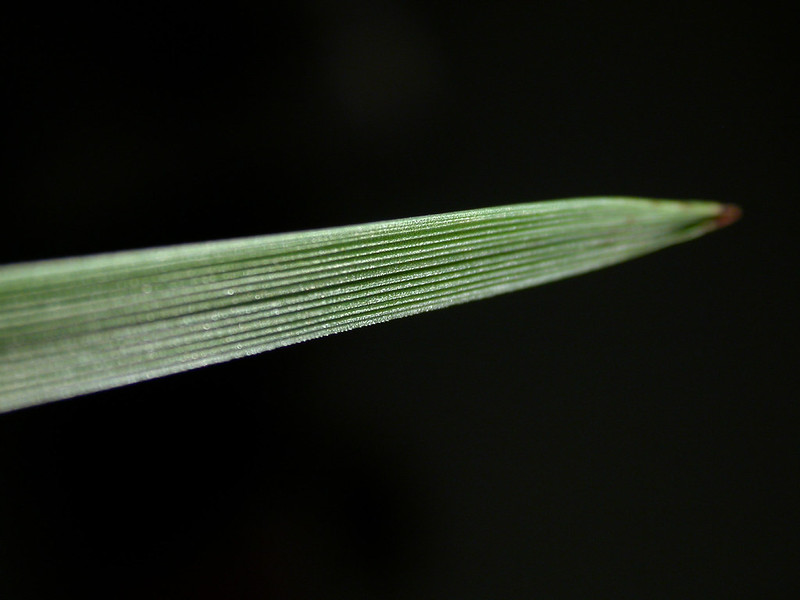
When it shows up as a contaminant in a fine-textured lawn, tall fescue (Schedonorus arundinaceus, formerly Festuca arundinacea) betrays itself by its coarse, wide, dark-green leaf blades that stand out conspicuously against finer turfgrasses such as Kentucky bluegrass, perennial ryegrass, or fine fescue. It grows as a bunch-type grass, forming distinct clumps or patches rather than spreading uniformly, and these clumps green up noticeably earlier in spring and stay green later into fall than the surrounding lawn. The upper leaf surface is strongly ribbed with prominent parallel veins (unlike the single midrib visible on bluegrass), the blade margins feel rough or saw-toothed when run between the fingers, and the leaf bases often show a reddish-purple tint. The ligule is short and membranous and auricles, when present, are small. Because forage-type or coarse common cultivars do not blend with finer lawn grasses, the result is an uneven, patchy appearance that is the main giveaway.
Symptoms & Damage
Tall fescue degrades a fine-textured lawn primarily through appearance rather than by killing surrounding grass: its coarse, wide blades, faster spring green-up, and clumping habit create a mottled, uneven, two-toned look that disrupts the uniform texture and color homeowners expect. The bunch-type clumps stand taller and feel rougher underfoot, recover at a different rate after mowing, and because they persist through summer stress while finer grasses thin, the patches become increasingly conspicuous and detract from the overall quality of the stand.
Biology
Tall fescue is a cool-season perennial bunchgrass that persists for many years from a deep, fibrous root system; older forage types have very short rhizomes but it does not spread aggressively, so it remains in expanding clumps rather than knitting together. It reproduces almost entirely by seed, and as a weed it most often arrives through contaminated seed mixes, old pasture-type seed in the soil, or volunteer seedlings. As a cool-season grass it grows most vigorously during the cooler, moist periods of spring and fall and slows during summer heat, though its deep roots give it strong drought and heat tolerance compared with bluegrass.
Occurrence & Spread
Tall fescue becomes a weed problem when coarse forage or pasture-type plants establish within a stand of finer cool-season turf, typically the result of low-quality or contaminated seed at establishment, overseeding with the wrong type, or invasion from adjacent rough areas. Because it tolerates heat, drought, and compaction better than many lawn grasses, individual clumps survive and even expand during summer stress periods when the surrounding turf thins, making the contrast more obvious over time.
Favorable Conditions
Contamination in seed/sod; persists in cool-season lawns.
Cultural Management
Because tall fescue is itself a desirable grass in many situations, there is no selective way to remove it culturally other than physical removal and prevention. For a few scattered clumps, dig or cut them out with a knife or spade, removing the crowns a couple of inches into the soil to get all the stems, then refill with soil and immediately reseed or sod with the desired turf species so weeds do not recolonize the bare spot. Prevent new infestations by using certified, high-quality seed free of coarse fescue contamination, choosing cultivars that match the existing lawn, and maintaining dense, vigorous turf so volunteer seedlings have little room to establish.
Further Reading
University extension resources — open in a new tab.
Related Reports
No published reports yet for this pest.
Reports will appear here as they are peer-reviewed and published.