
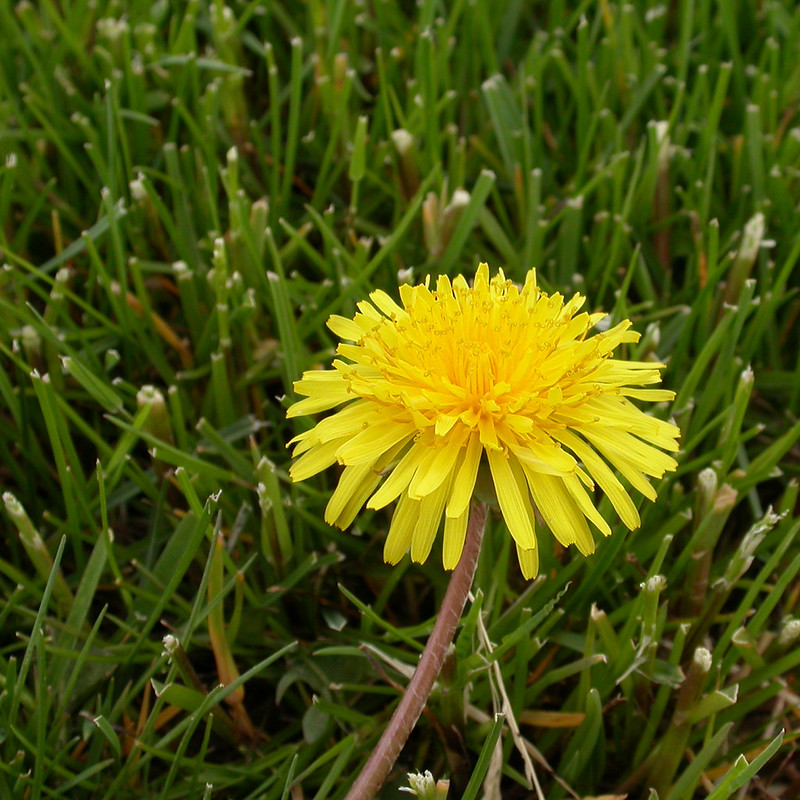
Dandelion
Taraxacum officinale
A perennial broadleaf with a deep taproot and bright yellow flowers turning to puffball seedheads.
Identification
Dandelion (Taraxacum officinale) is a familiar perennial broadleaf forming a basal rosette of deeply lobed leaves whose teeth point back toward the leaf base. Leaves are smooth and emerge directly from a thick, fleshy taproot at the crown; broken leaves and stems exude a milky sap. The bright yellow flower is borne singly atop a hollow, leafless stalk, maturing into the distinctive round, white puffball of plumed seeds carried by wind. The basal rosette, milky sap, and single yellow flower on a hollow stalk distinguish dandelion from look-alikes such as cat's ear and false dandelion, which have hairy leaves or branched flower stalks.
Symptoms & Damage
Dandelion degrades the stand by interrupting turf uniformity with flat rosettes that shade and crowd surrounding grass, leaving thin or bare spots when the rosette dies back. The bright flowers and conspicuous seed puffballs disrupt the appearance of an otherwise uniform lawn, and heavy flowering reseeds the area and spreads infestations to neighboring turf. Dense rosettes reduce turf density and competitiveness, accelerating further weed encroachment.
Biology
Dandelion is a long-lived perennial that persists by a deep, fleshy taproot capable of regenerating new shoots from the crown even after top growth is removed; pieces of taproot left in the soil can resprout. It reproduces prolifically by wind-dispersed seed, which can germinate over much of the growing season whenever moisture and light are adequate. The crown and root system remain alive after leaves die back in fall, and the plant flowers heavily in spring with a second flush often occurring in fall.
Occurrence & Spread
Dandelion invades thin, open, or stressed turf where wind-blown seed can reach bare soil and establish, and it is favored by low mowing, low fertility, drought stress, and any condition that reduces turf density. It colonizes lawns, roadsides, and disturbed areas readily and, once the taproot is established, persists for years and reseeds the surrounding area. Disturbed edges, recently seeded areas, and weakened stands are especially prone to invasion.
Favorable Conditions
Thin turf, sunny sites; seeds spread widely by wind.
Cultural Management
A dense, vigorously growing turf is the best defense, achieved through proper mowing height, balanced fertilization, and adequate irrigation so the stand outcompetes invading seedlings and shades out the soil surface. Hand-digging is effective for scattered plants but must remove the entire taproot, since fragments left behind will resprout. Mowing before the puffballs mature helps reduce seed production and spread, and promptly filling and reseeding thin or bare areas denies dandelion the open ground it needs to establish.
Further Reading
University extension resources — open in a new tab.
Related Reports
No published reports yet for this pest.
Reports will appear here as they are peer-reviewed and published.