
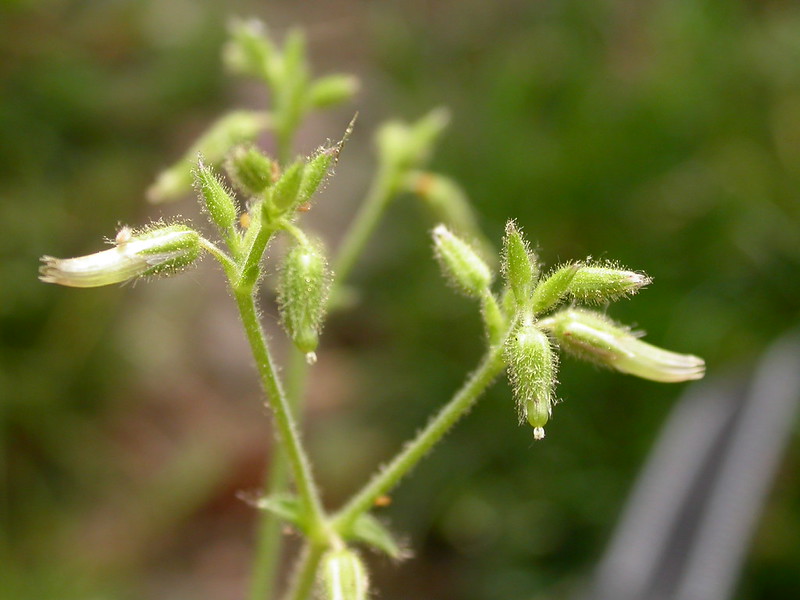
Mouseear chickweed
Cerastium fontanum
A low, mat-forming perennial with small hairy leaves; tougher and more persistent than common chickweed.
Identification
Mouseear chickweed (Cerastium fontanum ssp. vulgare) is a low, mat-forming perennial usually two to six inches tall with an equal or greater spread. Its leaves are opposite, dark green, oval to spatula-shaped with pointed tips and smooth margins, stalkless, and conspicuously covered in hairs, which is the key identifier and the source of the common name. The stems are prostrate and root at the nodes to form dense mats. Small white flowers appear to have ten petals but actually have five deeply notched petals. The dense hairiness separates it from common chickweed (Stellaria media), whose leaves are essentially hairless and whose stems bear only a single line of hairs down one side.
Symptoms & Damage
Mouseear chickweed's prostrate, rooting stems knit together into dense dark-green mats that crowd out turfgrass and create uneven, coarse-textured patches; because it grows low and roots at the nodes it persists under mowing and resists being cut out, reducing turf density and uniformity and leaving a weedy, matted surface that competes with grass for moisture, light, and nutrients.
Biology
Mouseear chickweed is a perennial that persists year to year and reproduces both by seed and vegetatively by prostrate stems that root at the nodes to form spreading mats. The rooting stems allow a single plant to expand into a dense patch, while seed adds to the soil seedbank and spreads it to new areas. It tolerates close mowing by growing prostrate and can remain green and active over a long season.
Occurrence & Spread
Mouseear chickweed is most common in turf and is favored by moist conditions and thin, low-mowed, or stressed stands where its mat-forming habit can take hold. It thrives across a wide range of sites but exploits open, damp turf and tolerates close mowing, so it is frequently found in lawns and other regularly cut areas, particularly where moisture is ample and turf density is low.
Favorable Conditions
Cool, moist, fertile soils; thin turf.
Cultural Management
A healthy, competitive turf is the best preventive: mow at the proper height (raising the cut helps, since this weed exploits close mowing), fertilize and water to maintain a dense canopy, and improve drainage where chronic moisture favors the weed. Hand-pulling is effective on small patches, especially when soil is moist so the rooting stems pull free, and in landscape beds a few inches of organic mulch suppresses establishment; repairing and overseeding thin areas keeps grass, not chickweed, in the openings.
Further Reading
University extension resources — open in a new tab.
Related Reports
No published reports yet for this pest.
Reports will appear here as they are peer-reviewed and published.