
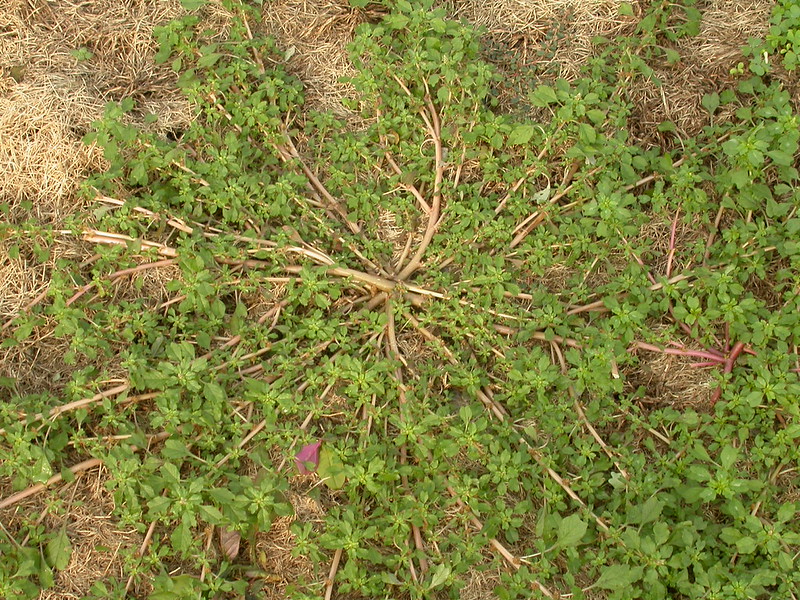
Spotted spurge
Euphorbia maculata
A prostrate summer annual with milky sap forming dense mats from a central taproot.
Identification
Spotted spurge (Euphorbia maculata, formerly Chamaesyce maculata) is a fast-growing summer annual that forms flat, prostrate mats radiating from a central taproot. Stems are slender, pinkish-red, and branch repeatedly along the ground; the small, opposite, oblong leaves usually carry a distinctive reddish-purple spot or blotch in the center of the blade. The single most reliable diagnostic trait is the milky white latex sap that exudes immediately when any stem or leaf is broken, which separates spurge from look-alikes such as prostrate knotweed (which lacks milky sap). Tiny, inconspicuous pinkish flowers occur in the leaf axils, and the mat habit with hairy stems and milky sap is characteristic.
Symptoms & Damage
In turf, spotted spurge forms dense, flat, spreading mats that smother and crowd thin or stressed grass, leaving unsightly weedy patches that are especially conspicuous in summer when the turf is weak. Because it tolerates close mowing and reseeds so rapidly, a few plants quickly multiply into broad mats that degrade density and uniformity, and the prostrate growth persists in exactly the open, stressed areas where desirable turf is struggling.
Biology
Spotted spurge is a warm-season summer annual reproducing entirely by seed, and it is an extremely prolific, fast seeder, able to flower and set seed within a few weeks of germination and to produce multiple generations in a single warm season. Seeds germinate as soils warm in late spring and summer (warm soil temperatures cue emergence), plants spread quickly into mats, and the rapid, repeated seed production builds a large, persistent seedbank before the plants die at frost.
Occurrence & Spread
It thrives in hot, dry conditions and is favored by thin, drought-stressed, compacted, and low-mowed turf, as well as bare soil, cracks, and edges. Spotted spurge is a classic colonizer of weak, open turf in summer heat, exploiting any thin or bare area where its warm-germinating seedlings find light and room; high-traffic, compacted, and under-irrigated stands are especially prone to invasion.
Favorable Conditions
Hot, dry, compacted, thin turf; germinates as soils warm.
Cultural Management
The most durable control is maintaining dense, vigorous, well-irrigated turf at the proper mowing height so there is no open, sunlit ground for the heat-loving seedlings to establish; correcting compaction and avoiding drought stress in summer removes the conditions spurge exploits. Because it sets seed so quickly, hand-pulling or removing young plants promptly, before they flower and reseed, is important to keep the prolific seedbank from building.
Further Reading
University extension resources — open in a new tab.
Related Reports
No published reports yet for this pest.
Reports will appear here as they are peer-reviewed and published.