
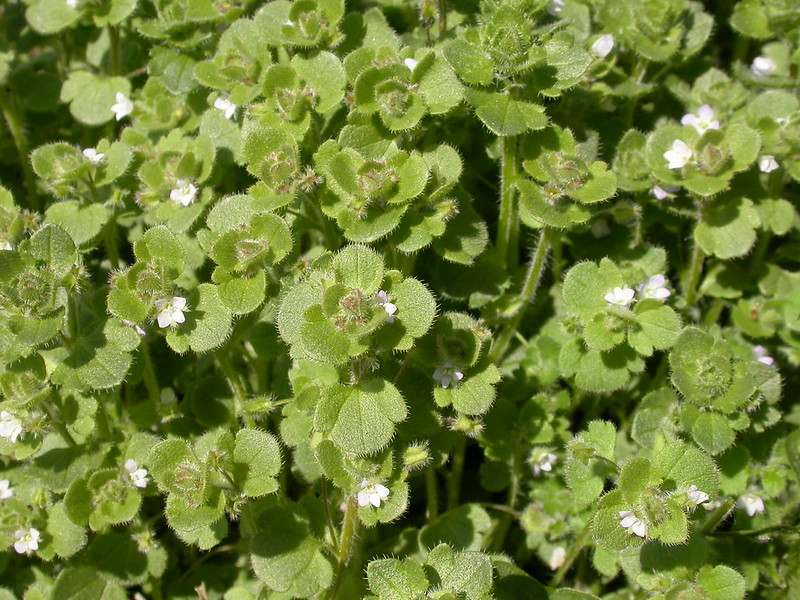
Ivyleaf speedwell
Veronica hederifolia
A winter-annual speedwell with ivy-like lobed leaves and small pale blue flowers.
Identification
Ivyleaf speedwell (Veronica hederifolia) is a small, low-growing winter annual broadleaf that creeps along the ground much like ivy. Its distinctive leaves are broadly rounded with three to five shallow lobes, are noticeably hairy, and are arranged alternately on prostrate, branching stems. Tiny pale blue to lavender flowers are borne singly on slender stalks (pedicels) that are longer than the subtending leaf is wide, a useful feature for separating it from corn speedwell and other Veronica species, which have shorter pedicels and differently shaped, more toothed leaves. The plant hugs the soil and forms sprawling low mats.
Symptoms & Damage
Ivyleaf speedwell creeps over the soil surface forming low, spreading mats that crowd out turfgrass seedlings and thin the stand in winter and early spring; the ivy-like patches interrupt turf uniformity, compete with grass during the cool-season growth period, and leave bare, weed-prone gaps when the annual plants senesce in early summer.
Biology
Ivyleaf speedwell is a winter annual: seeds germinate in fall or winter, plants grow opportunistically during warm spells while remaining largely low and inconspicuous through cold weather, then resume active growth, flower, and set seed in spring before dying as temperatures rise in late spring and early summer. Reproduction is by seed only, replenishing the seedbank that drives the next fall flush.
Occurrence & Spread
This weed quickly invades thin, open turf, especially where soil moisture is good, and shade can further encourage it. Sparse lawns going into fall, compacted or disturbed areas, field edges, and roadside grassy areas are typical entry points. As with other winter annuals, available soil-surface moisture during the fall germination window combined with an open canopy sets the stage for establishment.
Favorable Conditions
Cool, moist fall/spring; thin or disturbed turf.
Cultural Management
Maintaining a dense, competitive turf is the foundation of control: select adapted turfgrass cultivars and properly fertilize, mow, and water to keep the canopy thick enough to shade the soil and exclude germinating seedlings. Repair and overseed thin areas before fall so grass fills openings, reduce excessive shade and improve drainage where feasible, and hand-remove small patches before they flower and replenish the seedbank.
Further Reading
University extension resources — open in a new tab.
Related Reports
No published reports yet for this pest.
Reports will appear here as they are peer-reviewed and published.