
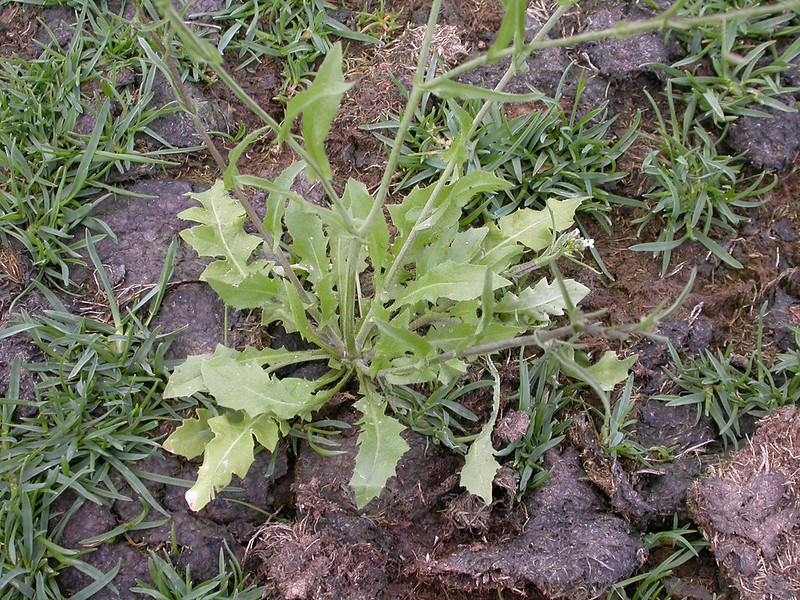
Shepherd's purse
Capsella bursa-pastoris
A cool-season winter annual of thin turf, recognized by its rosette of lobed leaves and slender stalks of heart-shaped (purse-like) seed pods.
Identification
Shepherd's purse (Capsella bursa-pastoris) is a winter annual (sometimes summer annual) broadleaf in the mustard family that begins as a basal rosette of deeply lobed, dandelion-like leaves with backward-pointing lobes. From the rosette it sends up one or more slender, branched flowering stalks bearing small four-petaled white flowers, followed by the unmistakable diagnostic feature: small, flattened, heart- or triangular-shaped (purse-shaped) seedpods arranged along the stalk, which give the plant its common name. The combination of the lobed basal rosette, white four-petaled mustard flowers, and the distinctive triangular seedpods readily separates it from other rosette-forming weeds.
Symptoms & Damage
In turf, shepherd's purse produces ground-hugging rosettes and then conspicuous upright flowering stalks topped with white flowers and triangular seedpods that rise above the canopy, creating an untidy, weedy appearance and disrupting uniformity in late winter and spring. Dense stands crowd thin cool-season turf during the establishment window and reseed heavily, so an unmanaged infestation persists and intensifies from the abundant seedbank.
Biology
Shepherd's purse is primarily a winter annual reproducing entirely by seed, and it is a prolific seed producer. Seeds germinate mainly in late summer and fall (and can also germinate in spring), forming overwintering rosettes that bolt, flower, and set abundant seed in spring before dying out; under favorable conditions it can complete a generation in spring as well. The large, long-lived seedbank ensures repeated reinfestation, and its rapid seed production lets populations build quickly in open ground.
Occurrence & Spread
It favors thin, open, disturbed, or newly seeded turf and cool-season conditions, and is common in recently renovated areas, low-fertility lawns, and any turf that is sparse going into fall. Bare or weak turf in autumn provides the open soil its fall-germinating seedlings exploit, so under-fertilized, compacted, or disturbed stands are the most readily invaded by this fast-cycling annual.
Favorable Conditions
Cool weather on thin turf, bare soil, and new seedings; fall and early spring.
Cultural Management
Maintaining dense, vigorous turf, especially going into fall, is the key to denying shepherd's purse the open ground its seedlings need; proper fertility, correct mowing height, and prompt overseeding of thin or renovated areas close the gaps it would otherwise colonize. Because it is shallow-rooted and easy to remove, hand-pulling or cultivating small infestations before the seedpods mature prevents replenishment of the prolific, long-lived seedbank.
Further Reading
University extension resources — open in a new tab.
Related Reports
No published reports yet for this pest.
Reports will appear here as they are peer-reviewed and published.