
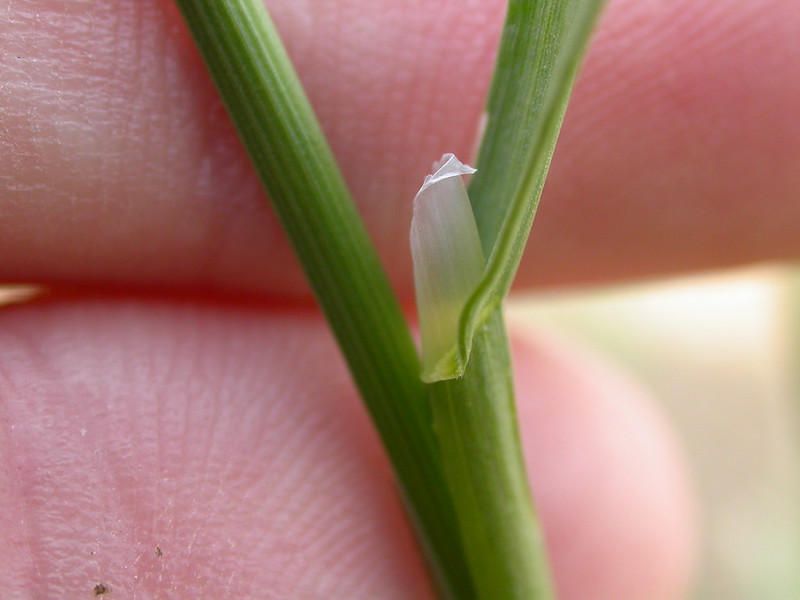
Orchardgrass
Dactylis glomerata
A coarse, clumpy cool-season grass that creates rough texture and disrupts turf uniformity.
Identification
Orchardgrass is a coarse, clump-forming cool-season grass with pronounced bunching growth habit. Leaf blades are coarse, flat, and keeled; plants reach heights well above the turf canopy and produce distinctive compressed, angular seed heads with clustered spikelets that give them a dense, beaded appearance. The basal shoots form tight tufts or bunches rather than spreading rhizomes, and the coarse texture is immediately obvious when contrasted with fine turf species.
Symptoms & Damage
Orchardgrass creates uneven, coarse clumps that stand above and disrupt the uniform fine texture of desirable turf, leaving a rough, cloddy appearance. The clumps darken in winter and spread over time, especially in thin or stressed stands, and their texture is distinctly out of place in high-quality lawns and fine turf.
Biology
Orchardgrass is a perennial grass that spreads primarily through tiller formation within the clump, though it can also reproduce by seed. Once established, plants persist indefinitely and enlarge slowly through basal shoot development. Seed production is prolific in spring, and the persistent seed bank allows new plants to establish in disturbed or thin areas.
Occurrence & Spread
It is a common contaminant of grass seed and enters lawns through imported seed, soil, or equipment. Once present it is most problematic in cooler regions and becomes increasingly visible during cool seasons when it grows more vigorously than surrounding turf. Thin or scalped turf and disturbed areas provide openings for establishment and enlargement.
Favorable Conditions
Well-drained soils, cool seasons, established in seed mixes or entering from adjacent areas.
Cultural Management
Hand-dig individual clumps when small, removing as much root mass as possible and filling the void with seed of the desired species. Maintain dense, vigorously competitive desired turf at the proper mowing height to slow expansion. For isolated orchardgrass plants, careful spot digging is most effective; avoid scalping, which creates niches for its spread. Bulk fertilization to favor the desired species and overseeding to maintain density help outcompete orchardgrass clumps over time.
Further Reading
University extension resources — open in a new tab.
Related Reports
No published reports yet for this pest.
Reports will appear here as they are peer-reviewed and published.