
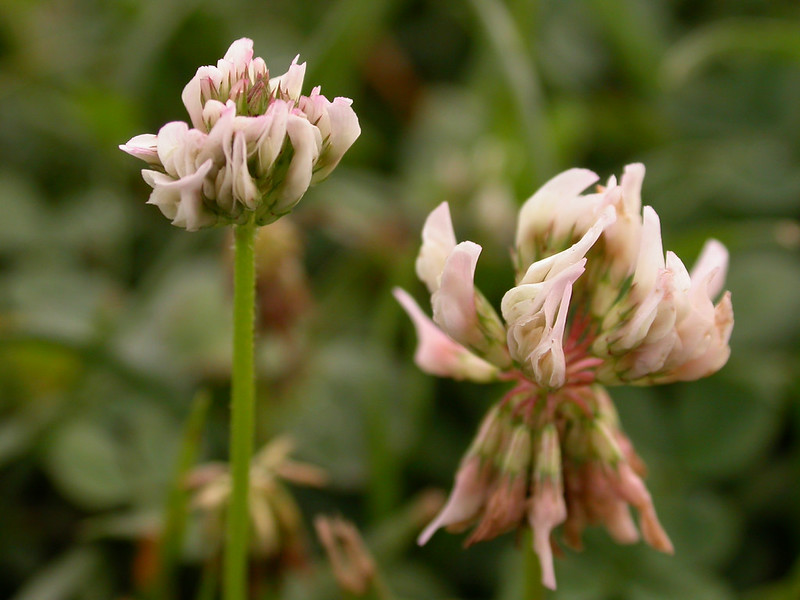
White clover
Trifolium repens
A creeping nitrogen-fixing legume with trifoliate leaves and white flowers that thrives in low-N turf.
Identification
White clover (Trifolium repens) is a low-growing perennial broadleaf weed in the legume family, easily recognized by its leaves divided into three rounded, oval leaflets (trifoliate) borne on long petioles, with each leaflet typically marked by a pale crescent-shaped or V-shaped watermark. It spreads by creeping stolons that root at the nodes and form dense patches that creep into thin turf. Its distinctive flowers are round, white to pinkish-white globe-shaped heads held on stalks above the foliage, blooming heavily in late spring and early summer and attracting bees. The combination of three watermarked leaflets, creeping rooting stems, and white ball-like flower heads separates it from look-alikes such as black medic or yellow woodsorrel, which have yellow flowers.
Symptoms & Damage
White clover degrades turf by forming conspicuous patches of broadleaf foliage and white flower heads that break up the uniform green appearance of the lawn, and the flowers attract bees, creating a stinging hazard for people walking barefoot. Its creeping stolons crowd out desirable grass in thin areas, the patches feel and look different in texture and color, and clover stays greener than drought-stressed turf, accentuating the contrast. While not as smothering as some mat-forming weeds, dense clover reduces the proportion of desirable turfgrass and gives the stand a weedy, uneven look, particularly when in bloom.
Biology
White clover is a perennial that spreads both by seed and vegetatively through creeping stolons that root at the nodes, allowing a single plant to colonize a wide area and persist for years. As a legume it forms a symbiotic relationship with nitrogen-fixing bacteria, giving it the ability to thrive in low-nitrogen soils where turfgrasses struggle. It grows actively in spring, summer, and fall, flowering most noticeably in late spring and early summer, and the long-lived seed in the soil along with the persistent rooting stolons make established patches difficult to remove permanently.
Occurrence & Spread
White clover is one of the most common weeds of home lawns and is especially favored by low soil fertility, since its nitrogen-fixing ability lets it outcompete turf where nitrogen is deficient. It grows best in full sun but also colonizes partially shaded and even adequately fertilized turf, and it readily invades thin, sparse stands. Under-fertilized, thin, or stressed lawns are the classic situation where white clover spreads, with its stolons creeping into any open or weakened areas of the turf.
Favorable Conditions
Low nitrogen fertility and thin turf.
Cultural Management
Because white clover thrives where nitrogen is low, the single most effective cultural tactic is maintaining adequate nitrogen fertility, since well-fertilized turf competes strongly and reduces clover encroachment. Beyond fertility, improving overall turf density through proper establishment, choosing well-adapted turfgrass species and cultivars, mowing at the correct height, and watering appropriately all help the lawn outcompete and shade out clover. Small patches can be hand-pulled, though the creeping stolons make complete removal difficult, so combining good fertility with dense, vigorous turf is the most reliable non-chemical approach to gradually crowd it out.
Further Reading
University extension resources — open in a new tab.
Related Reports
No published reports yet for this pest.
Reports will appear here as they are peer-reviewed and published.