
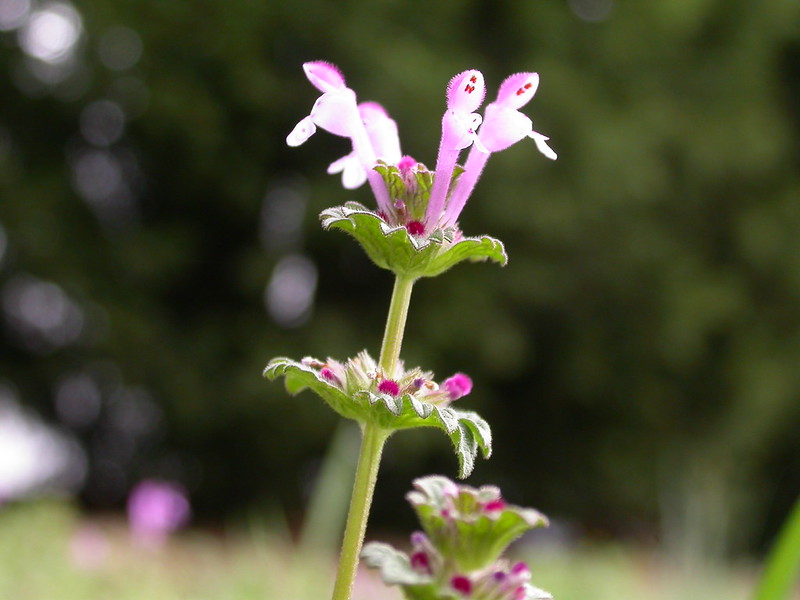
Henbit
Lamium amplexicaule
A winter annual mint with square stems and clasping scalloped leaves topped by purple flowers.
Identification
Henbit (Lamium amplexicaule) is a winter annual in the mint family, generally under about 12 inches tall, with the family's characteristic square stems. The leaves are opposite, rounded to heart-shaped with scalloped (crenate) margins and prominent veins; the lower leaves have distinct petioles while the upper leaves clasp the stem directly with no stalk, half-encircling it. In spring it produces whorls of tubular, two-lipped pinkish-purple to reddish-purple flowers, often with darker spots on the lower petals, clustered among the upper leaves. The clasping upper leaves and the green (not purplish) leaf color help separate henbit from the closely related purple deadnettle, whose upper leaves are petioled, triangular, and tinged purple.
Symptoms & Damage
Henbit forms low, sprawling patches that are most conspicuous in late winter and spring when the purple flowers bloom, giving lawns a weedy, mottled purple cast; the cool-season mats occupy space in the turf canopy, compete with grass for light, moisture, and nutrients during the establishment season, and leave thin, open areas behind when the plants die out in early summer.
Biology
Henbit is a winter annual. Seeds germinate primarily in early fall, with a secondary flush possible in early spring; plants overwinter as small rosettes, resume growth and bolt as temperatures warm in spring, flower and set seed, then die out as heat arrives in late spring and early summer. Reproduction is entirely by seed, which replenishes the soil seedbank for the next fall germination window. Germination is cued by cooling soils and surface moisture in autumn.
Occurrence & Spread
Henbit thrives in thin, open turf and disturbed ground where fall sunlight reaches the soil surface and moisture is available for germination. Lawns that are sparse going into autumn, areas thinned by summer stress or disease, and sites with bare or compacted soil are readily invaded. Adequate soil-surface moisture in fall is the key driver, so frequent light irrigation late in the season encourages establishment, while a dense canopy that shades the soil suppresses it.
Favorable Conditions
Cool moist fall conditions and thin turf; germinates in fall.
Cultural Management
A dense, vigorous turf is the best preventive: choose an adapted cultivar and fertilize, mow, and water to maintain a thick canopy that shades the soil surface and denies seeds the light and moisture they need to germinate. Because fall surface moisture is critical to establishment, water deeply but as infrequently as possible in autumn, and overseed or repair thin areas before the fall germination window so grass, not henbit, fills the gaps; hand-pulling is practical for small patches before they set seed.
Further Reading
University extension resources — open in a new tab.
Related Reports
No published reports yet for this pest.
Reports will appear here as they are peer-reviewed and published.