
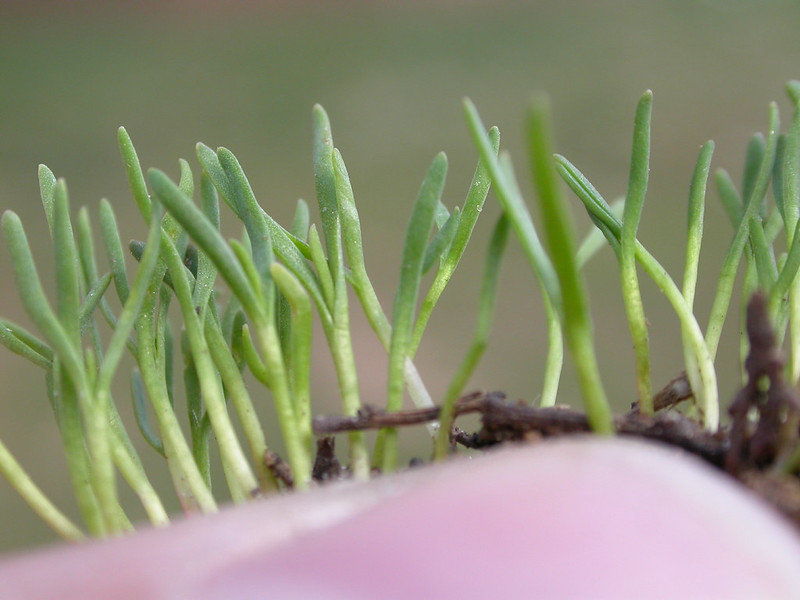
Prostrate knotweed
Polygonum aviculare
A wiry mat-forming summer annual that thrives in compacted soil and is an indicator of compaction.
Identification
Prostrate knotweed (Polygonum aviculare) is a low, wiry, mat-forming summer annual that radiates outward from a central taproot in a flat, tangled, often circular patch hugging the ground. Stems are slender, tough, and much-branched, with small bluish-green, oblong to lance-shaped leaves arranged alternately along them. Like its smartweed relatives it has a thin papery ocrea (membranous sheath) at each swollen node, which is a key diagnostic feature. Tiny, inconspicuous greenish-white to pinkish flowers are tucked in the leaf axils. Knotweed is frequently mistaken for early spreading spurge or for prostrate grasses, but it lacks the milky sap of spurge and has the wiry jointed stems and ocrea of the buckwheat family; it is one of the earliest summer annuals to germinate.
Symptoms & Damage
In turf, knotweed forms flat, dense, wiry mats in worn and compacted areas, smothering or excluding thin grass and leaving an unsightly, weedy patch that signals an underlying compaction problem. Its tough prostrate stems tolerate traffic and close mowing, so it persists in exactly the high-wear zones where turf is weakest, accentuating bare, hardened areas and reducing surface quality and uniformity.
Biology
Prostrate knotweed is a summer annual reproducing only by seed. It is among the first summer annuals to germinate, often emerging in very early spring while soils are still cool, sometimes before crabgrass. Plants spread into low mats through the growing season, flower and produce abundant seed in late summer, and die at frost; the seed overwinters and is long-lived in the soil.
Occurrence & Spread
Knotweed is a strong indicator of soil compaction and is classic on heavily trafficked, compacted, and poorly aerated sites, often appearing first along walkways, gateways, sidelines, paths, and high-wear areas where turf has thinned. It also tolerates drought and low fertility. Compacted, worn, open soil that grass cannot reoccupy provides the niche where its very early-germinating seedlings establish and dominate.
Favorable Conditions
Compacted, thin turf; germinates very early in spring.
Cultural Management
Because knotweed thrives on compaction, the foundation of control is relieving and preventing soil compaction through core aeration and by redistributing or limiting traffic in worn areas, followed by reestablishing dense turf in the bare spots it occupied. Improving fertility and maintaining vigorous, properly mowed grass closes the open niche, and because the weed germinates very early, hand removal or treatment of young plants in early spring before they mat and set seed is most effective.
Further Reading
University extension resources — open in a new tab.
Related Reports
No published reports yet for this pest.
Reports will appear here as they are peer-reviewed and published.