
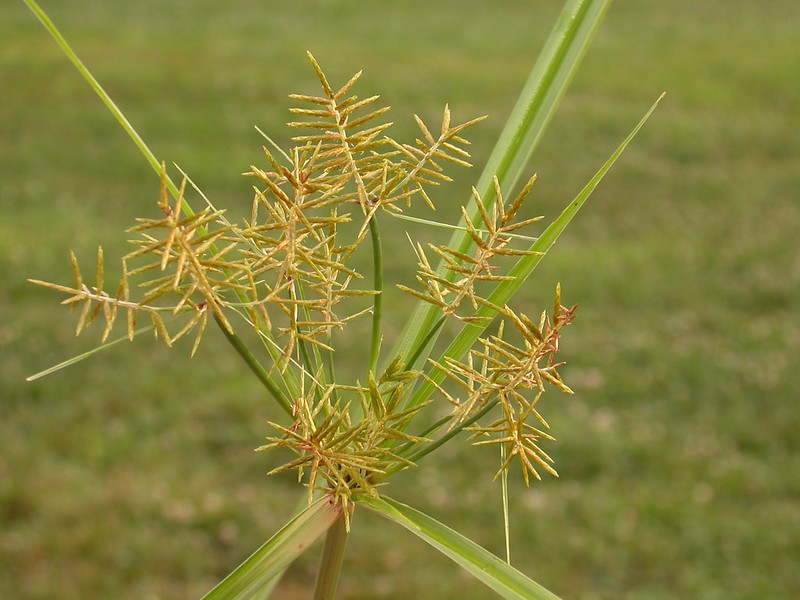
Yellow nutsedge
Cyperus esculentus
A fast-growing sedge (not a true grass) that emerges above turf in wet areas after rain or irrigation.
Identification
Yellow nutsedge (Cyperus esculentus) is a grass-like perennial that is neither a true grass nor a broadleaf but a sedge, and its single most reliable identifier is its triangular, solid stem, which can be felt as three distinct edges when rolled between the fingers. Its leaves are arranged in sets of three from the stem base, are yellow-green to light green, thicker and stiffer than most grass blades, V-shaped in cross section, and have a distinct waxy sheen with a prominent midrib that tapers to a fine point. It typically grows faster than the surrounding turf, standing taller within days of mowing, and where allowed to mature it produces a yellowish-brown to straw-colored, branched seedhead. Underground it forms small tubers (nutlets) at the tips of rhizomes, which are diagnostic when the plant is dug.
Symptoms & Damage
Yellow nutsedge degrades turf by producing rapidly growing, yellow-green, glossy shoots that stand conspicuously taller than the surrounding grass within days of mowing, creating a streaky, uneven, weedy appearance that disrupts the uniform texture and color of the lawn. Its faster growth and lighter color make it stand out, especially after mowing, and dense patches compete with turfgrass for water, nutrients, and light, thinning the stand. Because it regrows quickly from tubers, the patches recur and expand season after season, making it a persistent and unsightly blemish, particularly in wet areas.
Biology
Yellow nutsedge is a perennial that reproduces primarily by small underground tubers, called nutlets, that form at the ends of underground stems (rhizomes); a single plant can produce several hundred tubers in one summer, and these dormant tubers can remain viable in the soil for more than three years and emerge throughout the following seasons. It also spreads by rhizomes and to a lesser extent by seed. The tubers are the key to its persistence: they store energy, resist many control efforts, and germinate over an extended period, so removing or killing top growth alone does not eliminate the infestation.
Occurrence & Spread
Yellow nutsedge is favored by wet, poorly drained, or over-irrigated soils and is a frequent problem in low spots, areas with drainage issues, and turf that is watered excessively, although it can also persist in well-drained sites once established. It emerges and grows vigorously during the warm months, taking advantage of any thinning in the turf, and it spreads readily where soil and tubers are moved during construction, tillage, or sod handling. Chronically moist conditions are the classic trigger, so it often signals an underlying drainage or irrigation problem.
Favorable Conditions
Wet, poorly drained soils and excessive irrigation in summer.
Cultural Management
Cultural management starts with correcting the wet conditions that favor nutsedge: improve drainage, reduce overwatering, and fix irrigation problems so the soil is not chronically saturated, which both discourages the weed and strengthens the turf. Maintaining dense, vigorous turf through proper fertilization and mowing helps the lawn compete, and small, young infestations can be removed by hand-pulling or digging, but this must be repeated diligently because any tubers and rhizomes left behind will resprout, and pulling mature plants tends to leave tubers in the soil. Persistent removal of young plants before they form new tubers, combined with drainage correction, gradually depletes the tuber bank.
Further Reading
University extension resources — open in a new tab.
Related Reports
No published reports yet for this pest.
Reports will appear here as they are peer-reviewed and published.