
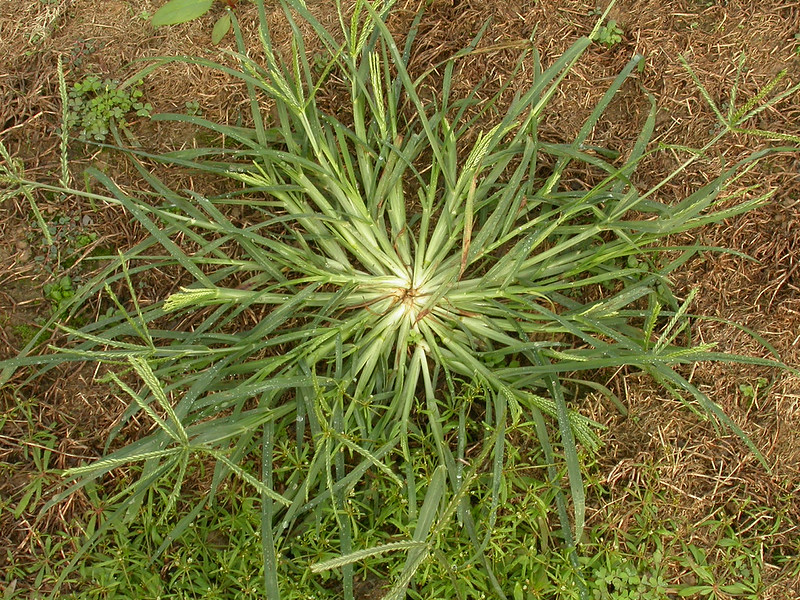
Goosegrass
Eleusine indica
A tough summer annual of compacted, wet areas, germinating later than crabgrass.
Identification
Goosegrass (Eleusine indica) is a summer annual grass that forms a prostrate, flattened rosette often described as a wagon-wheel, with stems radiating from a distinctive whitish to silvery center, earning it the nickname silver crabgrass. Blades are smooth and folded, and the flattened white base is a key identifier. Mature plants send up upright shoots and flowering stems bearing seedheads with two to several finger-like spikes that resemble a zipper, with seeds arranged in two rows along each spike. Its silvery flattened center and tougher, more clump-forming habit separate goosegrass from crabgrass, which is lighter green and roots at the nodes; goosegrass stems do not root at the nodes.
Symptoms & Damage
Goosegrass degrades the stand by forming tough, coarse, dark-green clumps with conspicuous silvery centers that contrast sharply with finer turf and create an uneven surface, particularly damaging on closely mowed sports turf and golf surfaces. Its strong root system and prostrate, traffic-tolerant habit let it dominate compacted, worn areas where desirable turf is already thin, crowding out the stand and disrupting playability. The prolific seed it produces ensures heavy reinfestation if left uncontrolled.
Biology
Goosegrass is a warm-season summer annual that reproduces by seed and is a prolific seed producer, with a single plant capable of producing well over one hundred thousand seeds. It germinates later than crabgrass, typically when soil temperatures reach roughly 60 to 65 degrees F, often two or more weeks after crabgrass, with germination promoted by fluctuating day and night temperatures and light at the soil surface. Although its stems do not root at the nodes, established plants develop a strong, fibrous root system that makes them very difficult to pull or kill once mature.
Occurrence & Spread
Goosegrass thrives in compacted, thin, and stressed turf and in hot, sunny, high-traffic areas such as sports fields, paths, and bunker edges, as well as in wet or poorly drained spots. Compaction and low mowing favor it heavily, and its later germination means preemergence applications timed only for crabgrass often run out of residual before goosegrass emerges. In warm climates it can survive year-round, so mature plants may already be present at the start of the season, reducing the effectiveness of preemergence herbicides.
Favorable Conditions
Compaction, wet soils and high temperatures; germinates a few weeks after crabgrass.
Cultural Management
Because goosegrass is so strongly favored by compaction and stress, relieving soil compaction through aeration and managing traffic are central cultural controls, along with maintaining a dense, vigorous stand via proper mowing height, balanced fertility, and appropriate irrigation; raising the mowing height where feasible reduces its advantage. Improving drainage in wet areas and promptly reseeding thin or worn spots denies goosegrass the open, compacted ground it needs. Young plants can be removed by hand before they develop the tough fibrous root system that makes mature plants nearly impossible to pull.
Further Reading
University extension resources — open in a new tab.
Related Reports
No published reports yet for this pest.
Reports will appear here as they are peer-reviewed and published.