
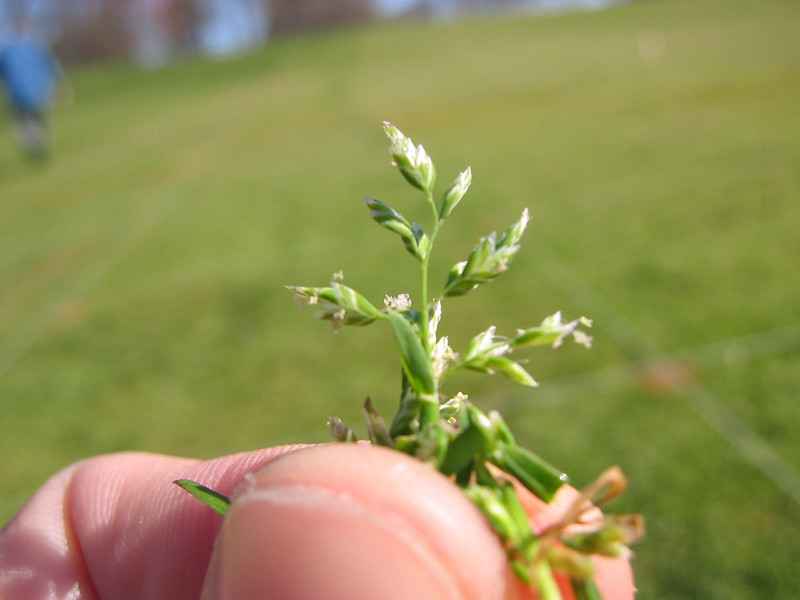
Annual bluegrass (Poa annua)
Poa annua
A highly adaptable weed (and sometimes managed turf) that produces prolific seedheads and struggles under stress.
Identification
Annual bluegrass is a low-growing, clump-forming or spreading grass that stands out from desirable turf by its distinctly yellow-green, almost apple-green color. The leaf blades are soft, smooth, and folded in the bud, tapering to a characteristic boat-shaped (prow-shaped) tip, and they often appear crinkled or wrinkled near the middle. Its most recognizable feature is the prolific production of whitish, branched seedheads that sit just above or even within the turf canopy, giving infested areas a speckled white cast even under very low mowing. Plants have shallow, fibrous roots and a bunch-type or weakly spreading habit. It is most easily distinguished from rough bluegrass and creeping bentgrass by its lighter color, boat-shaped leaf tip, and the relentless production of seedheads at almost any mowing height.
Symptoms & Damage
Infested turf develops a patchy, uneven appearance with light yellow-green clumps that contrast sharply against darker desirable grass, and the surface takes on a whitish, speckled look from the abundant seedheads that disrupt a uniform playing surface or lawn. Because the plants are shallow-rooted winter annuals, the patches they occupy thin out and turn brown when the weed dies back in summer heat, leaving voids that invite further weed encroachment and degrade the density, color, and smoothness of the stand.
Biology
Poa annua is best known as a winter annual, although perennial biotypes also persist in closely mowed turf. Seed germinates in late summer and early fall once soil temperatures drop below roughly 70 degrees F; seedlings mature and overwinter in a vegetative state, then flower and set seed heavily from spring into early summer before the parent plants typically decline in summer heat. The species reproduces almost entirely by seed, and it is an extraordinarily prolific seeder, with a single plant capable of producing several hundred viable seeds even when mowed very short. This combination of fall germination, spring seeding, and an enormous, long-lived seed bank makes reinfestation a continuous pressure.
Occurrence & Spread
Annual bluegrass thrives where turf is stressed, thin, or kept very short and where soil stays moist and compacted. Closely mowed, heavily irrigated, and compacted sites such as golf greens, fairways, athletic fields, and over-watered lawns are classic strongholds because the low canopy and frequent moisture favor germination and seedling survival. High soil moisture, soil compaction, shade, and excess early-spring nitrogen all tip conditions in its favor, as do thin or worn areas that expose soil to the seed bank. It invades most aggressively in fall during the germination window and becomes most conspicuous in spring when it flowers.
Favorable Conditions
Cool, moist conditions, compaction and moist seedbeds in late summer/fall.
Cultural Management
The foundation of cultural management is a dense, vigorously competitive stand maintained at the higher end of the recommended mowing range for the species, since taller turf shades the soil and discourages germination of this light-loving seedling. Avoid the conditions that favor it: relieve compaction with core aeration, improve drainage, and irrigate deeply but infrequently rather than keeping the surface constantly wet. Withhold heavy nitrogen in early spring when it is competing strongly, fill in thin or worn areas promptly to deny the seed bank open soil, and where practical hand-remove isolated clumps before they seed to slow replenishment of the seed bank.
Further Reading
University extension resources — open in a new tab.
Related Reports
No published reports yet for this pest.
Reports will appear here as they are peer-reviewed and published.