
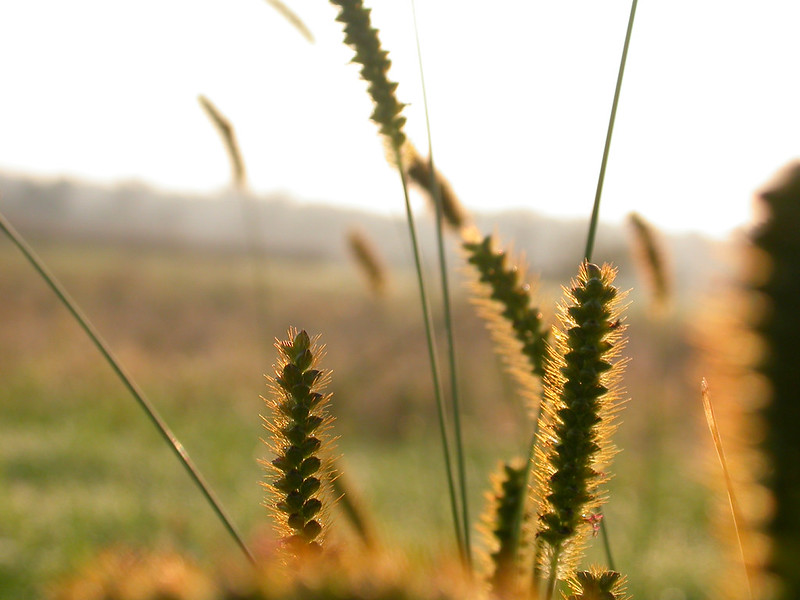
Yellow foxtail
Setaria pumila
A summer-annual grass with a bristly, foxtail-like seed head, common in thin or newly seeded turf.
Identification
Yellow foxtail (Setaria pumila, formerly S. glauca) is a warm-season annual grass that forms coarse, upright to spreading bunch-type clumps, often branching at the base and sometimes rooting at the lower nodes, with flattened stems that are frequently reddish near the base. Its most diagnostic feature is the seedhead: a dense, upright, narrow, cigar-shaped spike (the 'foxtail') bristling with yellowish, soft bristles that turn yellow-brown at maturity in mid to late summer. The leaf blades are flat and twisted, and a key identifier is a tuft of long, silky hairs at the base of the upper leaf surface near the collar, present only at the leaf base rather than along the whole blade, which helps separate yellow foxtail from green and giant foxtail.
Symptoms & Damage
Yellow foxtail degrades turf by establishing coarse, fast-growing clumps that contrast sharply in texture and color with finer turfgrass, and by mid to late summer the conspicuous yellow bristly seedheads rise above the mown surface, giving the lawn a weedy, unkempt appearance. The bunch-type clumps compete with thin turf for light, water, and nutrients during the summer, accentuating bare and weak areas, and when the annual plants die at season's end they leave gaps that further reduce turf density and set the stage for reinfestation from the seed they have shed.
Biology
Yellow foxtail is a summer annual that completes its entire life cycle in one growing season and reproduces solely by seed. Seeds germinate when soil temperatures warm, generally in the range of about 68 to 95 degrees Fahrenheit, with emergence occurring from mid-spring into early summer; the plants grow into bristly-topped clumps through summer, set seed from roughly July through September, and then die at the end of the season, leaving abundant seed in the soil to germinate the following year.
Occurrence & Spread
Yellow foxtail is favored by thin, open, low-maintenance turf and disturbed or newly established sites, invading lawns, parks, athletic fields, grounds, roadsides, and new seedings where the desirable stand is sparse. As a warm-season annual it exploits the summer period when cool-season turf may thin under heat and drought stress, filling gaps in weak or bare areas. Dense, healthy turf strongly resists it, so the weed is most problematic where turf vigor and density are low and where soil has been recently disturbed.
Favorable Conditions
Warm soils, thin or new turf, disturbed ground.
Cultural Management
The most effective cultural defense against yellow foxtail is maintaining a healthy, dense turf stand, because the weed cannot gain a foothold where vigorous turfgrass dominates the surface. Proper fertilization, correct mowing height, and appropriate irrigation to keep the stand thick, along with prompt overseeding and repair of thin or bare spots, deny the annual the open space and light it needs to germinate and establish. Minimizing soil disturbance and competing the turf aggressively during summer, when foxtail emerges, are the key non-chemical tactics, supplemented by spot removal of isolated clumps before they set seed.
Further Reading
University extension resources — open in a new tab.
Related Reports
No published reports yet for this pest.
Reports will appear here as they are peer-reviewed and published.