
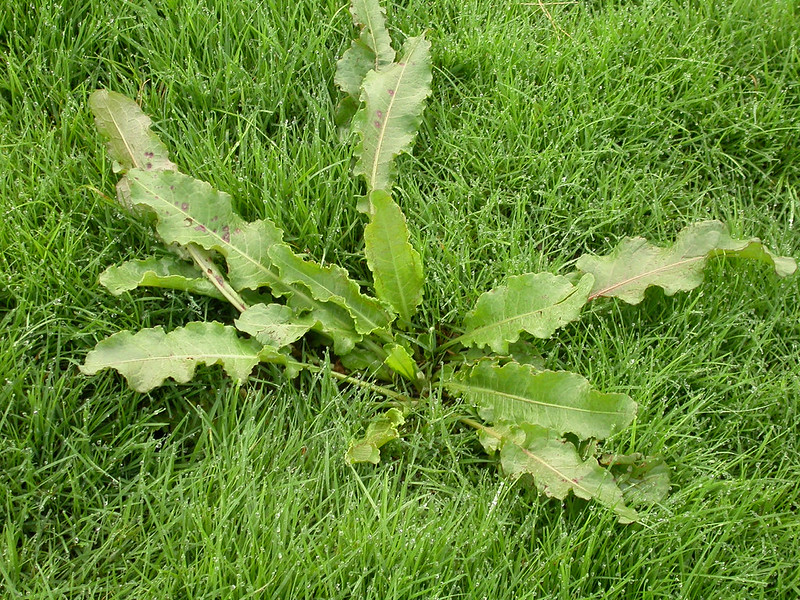
Curly dock
Rumex crispus
A taprooted perennial with large wavy-margined leaves and reddish, rust-colored seed stalks.
Identification
Curly dock (Rumex crispus) is a coarse perennial broadleaf recognized by a basal rosette of long, lance-shaped leaves 6 to 8 inches long and 1 to 2 inches wide. The single most reliable trait is the leaf margin, which is distinctly wavy or crisped (curled), giving the plant its name. Leaves are often reddish at the base and emerge from a stout, fleshy yellow taproot. A papery sheath (ocrea) wraps the stem at each node, a hallmark of the buckwheat family. As plants mature they bolt into a tall reddish-brown flower stalk bearing dense clusters of small greenish flowers that turn into conspicuous rusty-brown, three-winged seed structures that persist into winter. The wavy margin and large taproot distinguish it from broadleaf plantain and from related docks such as broadleaf dock, which has flatter, broader leaves.
Symptoms & Damage
Curly dock degrades the stand by forming large, coarse-textured rosettes that crowd out fine turfgrasses and leave bare or thin patches when the weed dies back. Its broad basal leaves shade and smother neighboring grass, while tall bolting seed stalks disrupt turf uniformity and playability and the persistent rusty seedheads create an unkempt appearance. Heavy infestations in wet, compacted areas accelerate stand decline and reseed the area year after year.
Biology
Curly dock is a simple perennial that reproduces almost entirely by seed and regenerates from its deep, persistent taproot. A single plant can produce thousands of long-lived seeds that remain viable in the soil seed bank for decades. Seedlings emerge primarily in spring and fall when soil moisture is adequate, establish a basal rosette in the first season, and bolt to flower the following year, although established crowns flower and reseed annually. Because top growth dies back but the taproot survives, mowing or cutting the crown often allows vigorous regrowth, making the root the key target for lasting control.
Occurrence & Spread
Curly dock favors moist to wet, poorly drained, and compacted sites, thriving in low spots, drainage areas, ditch banks, and thin or disturbed turf. It tolerates a wide range of soils and is common where the stand has been weakened by waterlogging, scalping, or low fertility. New infestations typically establish from seed in open ground in spring and fall, after which the deep taproot lets the plant persist and expand even as surrounding turf recovers.
Favorable Conditions
Moist soils and thin or low-maintenance turf.
Cultural Management
The foundation of cultural management is a dense, vigorous turf maintained through selection of adapted turfgrass species and cultivars combined with proper mowing, balanced fertilization, and appropriate irrigation to encourage competitive growth. Correcting the wet, compacted, poorly drained conditions that favor curly dock, by improving drainage and relieving compaction, removes its competitive advantage. For individual plants, digging or uprooting to remove as much of the taproot as possible, then burying or destroying the crown, prevents regrowth, and routine mowing before plants set seed reduces replenishment of the seed bank.
Further Reading
University extension resources — open in a new tab.
Related Reports
No published reports yet for this pest.
Reports will appear here as they are peer-reviewed and published.