Cogongrass
Imperata cylindrica
A federally noxious, highly invasive rhizomatous perennial grass forming dense, flammable monocultures.
Identification
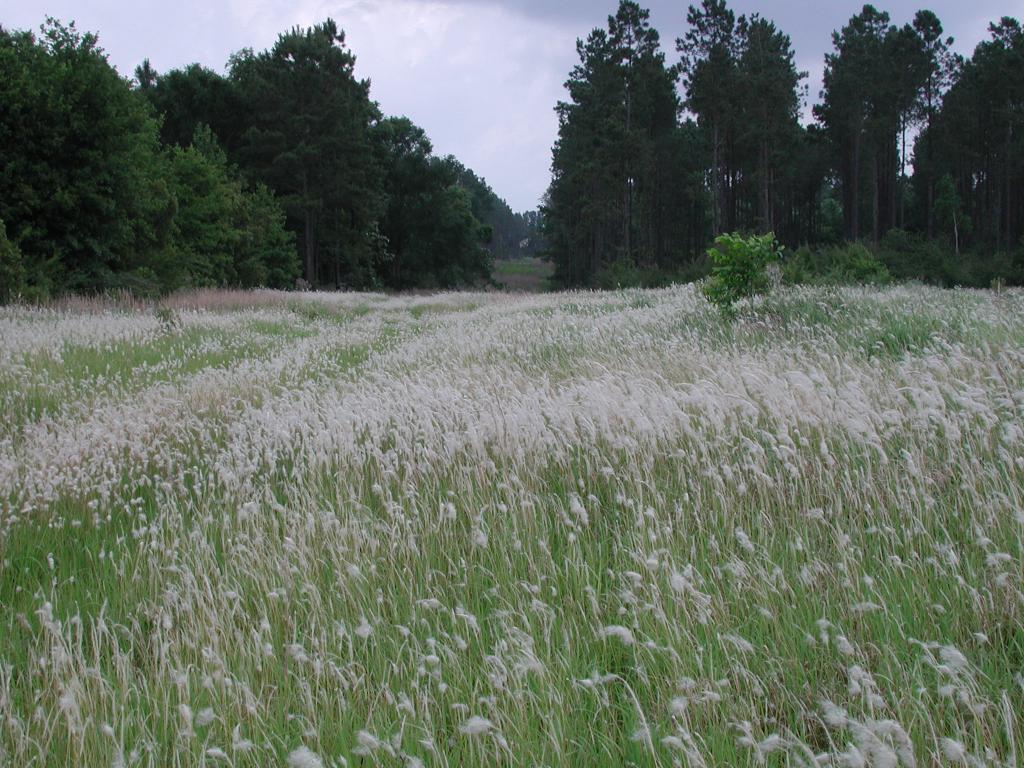
An aggressive warm-season perennial grass forming dense circular patches, with erect yellowish-green leaf blades that have a distinctly off-center (asymmetrical) whitish midrib and finely serrated, sharp margins. Sharp, scaly, white rhizomes spread underground. In spring it produces fluffy, silvery-white, cylindrical seedheads. The off-center white midrib, sharp rhizomes, and silky plume are diagnostic. It is a federal noxious weed.
Symptoms & Damage
Dense circular patches of yellow-green, sharp-edged grass with silvery plumes and white rhizomes displace all other vegetation and resist ordinary control.
Biology
A perennial spreading aggressively by extensive sharp rhizomes and by wind-dispersed seed; rhizomes store energy and resprout vigorously, allowing it to form dense, self-perpetuating monocultures that displace all other vegetation and increase fire risk.
Occurrence & Spread
A severe invasive of the southeastern US on roadsides, rights-of-way, disturbed ground, and unmanaged areas; spread by contaminated fill, equipment, and seed. Regular mowing does not eradicate it because of the rhizome reserves. Report and manage promptly where regulated.
Favorable Conditions
Disturbed ground, rights-of-way, warm climates; spread by equipment/fill.
Cultural Management
Prevent spread by cleaning equipment and avoiding movement of contaminated soil/fill. Repeated tillage or mowing weakens but does not eliminate rhizomes; integrated, persistent management is required. Early detection and rapid response are critical because established stands are extremely difficult to remove.
Further Reading
University extension resources — open in a new tab.
Related Reports
No published reports yet for this pest.
Reports will appear here as they are peer-reviewed and published.