Juniper leaf (rustweed)
Polypremum procumbens
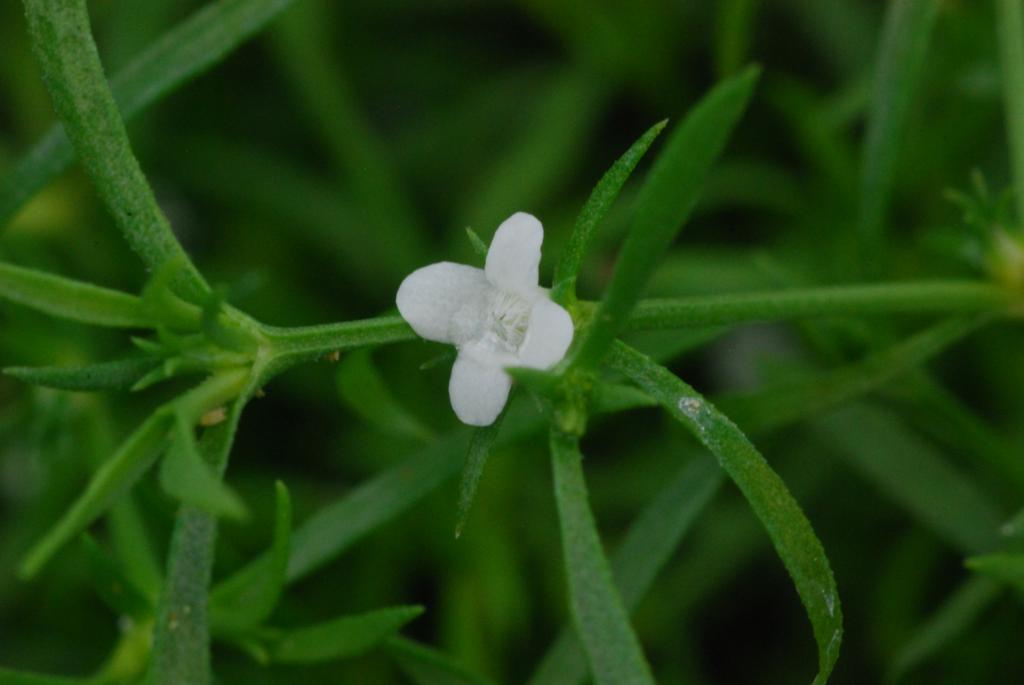
A low, wiry, mat-forming weed with narrow needle-like leaves and tiny four-petaled white flowers.
Identification
A low, spreading, much-branched plant forming flat mats, with small, narrow, stiff, needle- or awl-like opposite leaves (juniper-like) crowded along the wiry stems, and tiny white four-petaled flowers in the branch forks. The foliage often turns rusty-orange with age or stress, giving the name rustweed. Its wiry mats of narrow needle-like leaves are diagnostic.
Symptoms & Damage
Low, wiry mats of narrow needle-like leaves, often rust-tinged, appear on dry, sandy, thin warm-season turf and roadsides.
Biology
Behaves as a warm-season annual or short-lived perennial reproducing by seed; forms low mats on poor, sandy, disturbed soils and tolerates drought and low fertility.
Occurrence & Spread
A weed of dry, sandy, disturbed, low-fertility sites, roadsides, and thin warm-season turf in the southern and coastal US; favored by droughty, poor soils and open ground.
Favorable Conditions
Dry, sandy, low-fertility, disturbed ground.
Cultural Management
Improve fertility and turf density to reduce establishment on poor sites; mow to limit seed set. Hand-pull or cultivate mats before seeding.
Further Reading
University extension resources — open in a new tab.
Related Reports
No published reports yet for this pest.
Reports will appear here as they are peer-reviewed and published.