
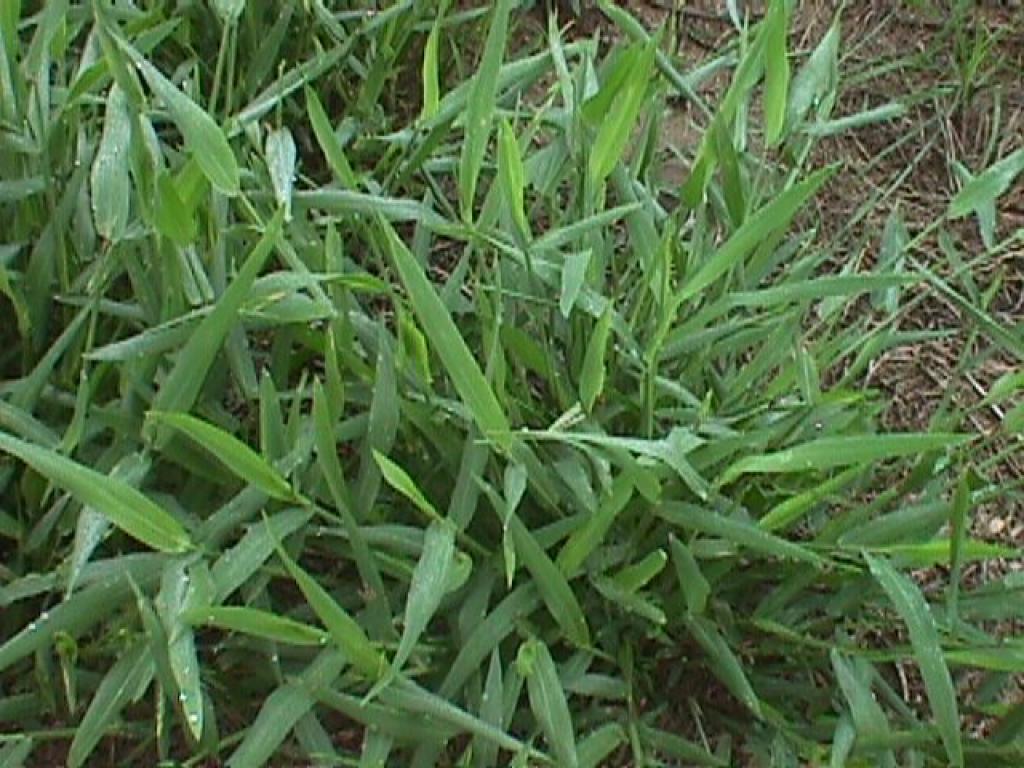
Broadleaf signalgrass
Urochloa platyphylla (syn. Brachiaria platyphylla)
A spreading summer-annual grass with wide blades that roots at the nodes and invades thin warm-season turf.
Identification
A summer-annual grass with a low, spreading to ascending habit that roots at the lower nodes. Leaf blades are relatively short and notably wide with slightly wavy margins, and the sheaths and blade margins bear hairs. The seedhead has several one-sided (signal-like) spike branches arranged along a central axis, with spikelets in two rows. Its wide blades and node-rooting, spreading habit distinguish it from crabgrass.
Symptoms & Damage
Wide-bladed, spreading grass patches that root at the nodes appear in thin warm-season turf, contrasting in texture and crowding desirable grass.
Biology
A summer annual reproducing by seed and rooting at stem nodes; emerges as soils warm and spreads to form patches, setting abundant seed before frost.
Occurrence & Spread
A weed of the southern US in cultivated fields, thin warm-season turf, and disturbed ground; favored by open canopies, moisture, and warm soils.
Favorable Conditions
Warm, moist soils; thin or open turf.
Cultural Management
A dense, vigorous warm-season stand maintained through proper mowing, fertility, and irrigation resists invasion; overseed and reduce compaction in thin areas. Node-rooting means fragments can re-establish, so remove whole plants when hand-weeding.
Further Reading
University extension resources — open in a new tab.
Related Reports
No published reports yet for this pest.
Reports will appear here as they are peer-reviewed and published.