
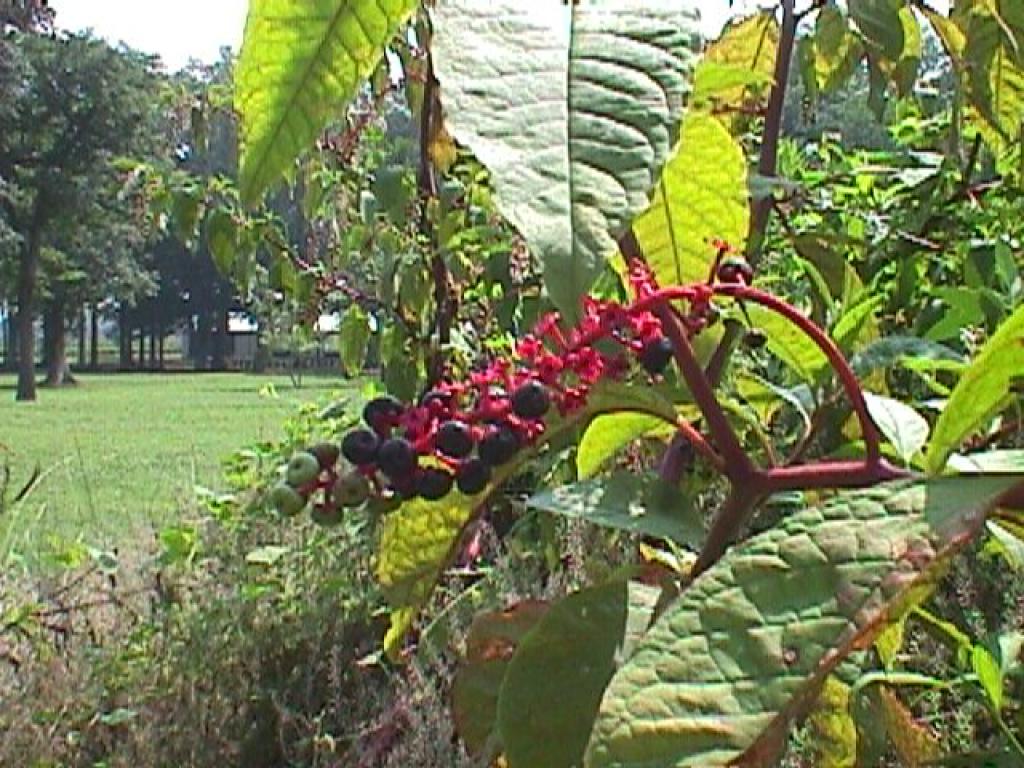
Common pokeweed
Phytolacca americana
A large perennial with reddish-purple stems, big leaves, and drooping clusters of dark purple berries; toxic.
Identification
A large, robust perennial that dies back each winter and regrows from a massive taproot, with thick, smooth, often reddish-purple stems, large ovate leaves, and drooping clusters (racemes) of small white-green flowers followed by conspicuous flattened, dark purple-black berries on pink-red stalks. Its size, purple stems, and hanging purple berry clusters are unmistakable. All parts, especially root and berries, are toxic.
Symptoms & Damage
Large, purple-stemmed plants with hanging dark berry clusters appear on margins, roughs, and beds, regrowing from a large taproot; all parts toxic.
Biology
A long-lived perennial reproducing by bird-dispersed seed and regrowing each year from a large fleshy taproot; the taproot resprouts vigorously after top removal, making mature plants hard to kill.
Occurrence & Spread
A weed of fence lines, field edges, roughs, beds, and disturbed ground across the eastern US; regular mowing controls seedlings in turf, so it is chiefly a margin and bed problem where the taproot can establish.
Favorable Conditions
Disturbed, rich margins; perennial taproot aids persistence.
Cultural Management
Routine mowing eliminates seedlings from turf. On margins and beds, dig out young plants while the taproot is small, since established roots resprout and are difficult to remove by cutting alone; prioritize removal near people and pets due to toxicity.
Further Reading
University extension resources — open in a new tab.
Related Reports
No published reports yet for this pest.
Reports will appear here as they are peer-reviewed and published.