
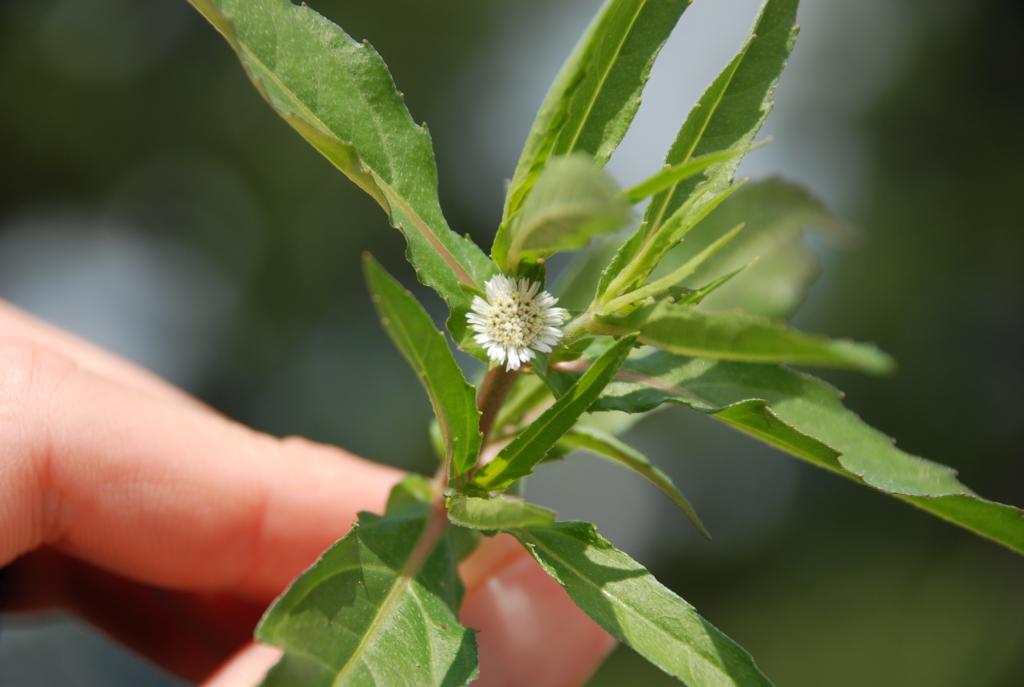
Eclipta (false daisy)
Eclipta prostrata
A warm-season annual of wet sites with small white button-like flowers and opposite, rough leaves.
Identification
A prostrate to ascending warm-season annual with opposite, lance-shaped, rough-hairy leaves on branching stems that root at the lower nodes, and small white daisy-like flower heads (button-like) on slender stalks from the leaf axils. Broken stems may show a dark sap. Its opposite rough leaves, node-rooting habit, and small white button flowers are diagnostic.
Symptoms & Damage
Prostrate, rough-leaved plants with small white button flowers form patches in moist, warm-season turf and wet spots, indicating excess moisture.
Biology
A seed-reproducing warm-season annual that also roots at stem nodes; thrives in wet conditions and reseeds prolifically, completing its cycle quickly.
Occurrence & Spread
A weed of moist to wet, warm sites — irrigated turf, low areas, ditch edges, nurseries, and rice culture in the southern US; strongly favored by excess moisture and poor drainage.
Favorable Conditions
Wet, poorly drained, warm sites.
Cultural Management
Correct excess moisture and improve drainage, the key cultural lever, and maintain a dense stand; reduce overwatering. Remove whole plants when hand-weeding since it roots at nodes.
Further Reading
University extension resources — open in a new tab.
Related Reports
No published reports yet for this pest.
Reports will appear here as they are peer-reviewed and published.