
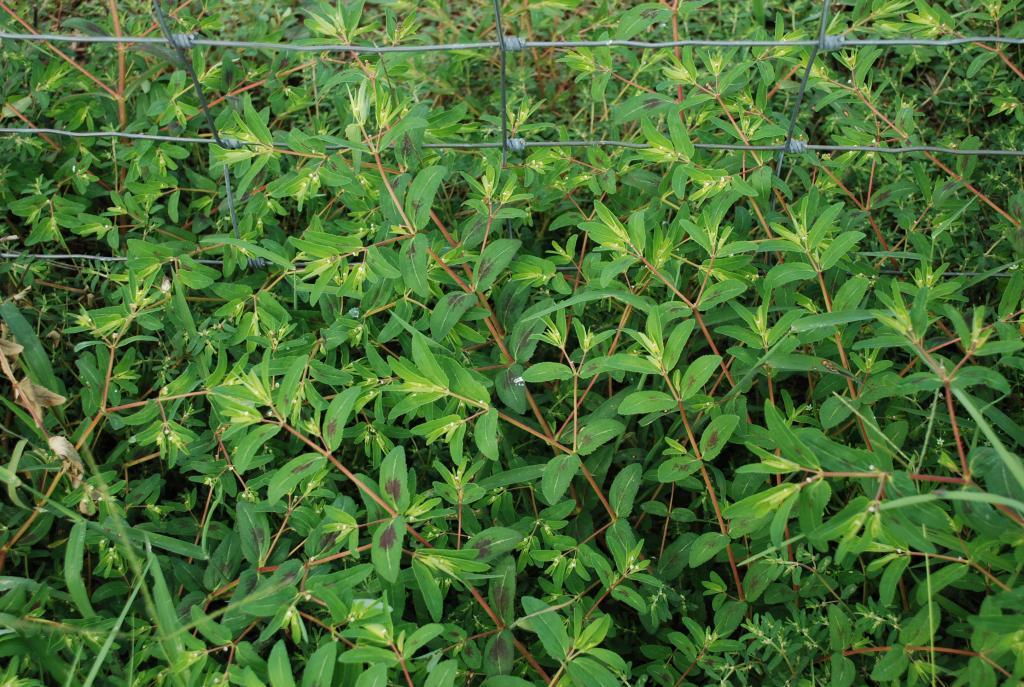
Hyssop spurge
Euphorbia hyssopifolia (syn. Chamaesyce hyssopifolia)
An erect to ascending summer-annual spurge with milky sap, related to spotted spurge and common in warm-season turf.
Identification
A summer-annual spurge with slender, branching, often reddish stems that are more upright than prostrate spotted spurge, bearing small, opposite, oblong leaves that are frequently toothed toward the tip and sometimes red-blotched. Broken stems exude milky white sap (latex), a hallmark of the spurge group. Tiny cup-like flower structures form in the upper axils.
Symptoms & Damage
Branching, milky-sapped spurge plants appear in thin warm-season turf, beds, and cracks, reseeding quickly and competing with turf.
Biology
A prolific seed-reproducing summer annual that germinates through the warm season and can set seed quickly on a short life cycle, building a persistent seed bank.
Occurrence & Spread
A weed of thin warm-season turf, landscape beds, nursery containers, sidewalk cracks, and disturbed ground; favored by heat, open canopies, and compacted or dry soils.
Favorable Conditions
Hot, dry, compacted, or open soils.
Cultural Management
Maintain a dense, vigorous stand to shade the soil and prevent germination; relieve compaction and reseed thin areas. Hand-pull scattered plants before seed set (the milky sap can irritate skin), and mulch beds to suppress emergence.
Further Reading
University extension resources — open in a new tab.
Related Reports
No published reports yet for this pest.
Reports will appear here as they are peer-reviewed and published.