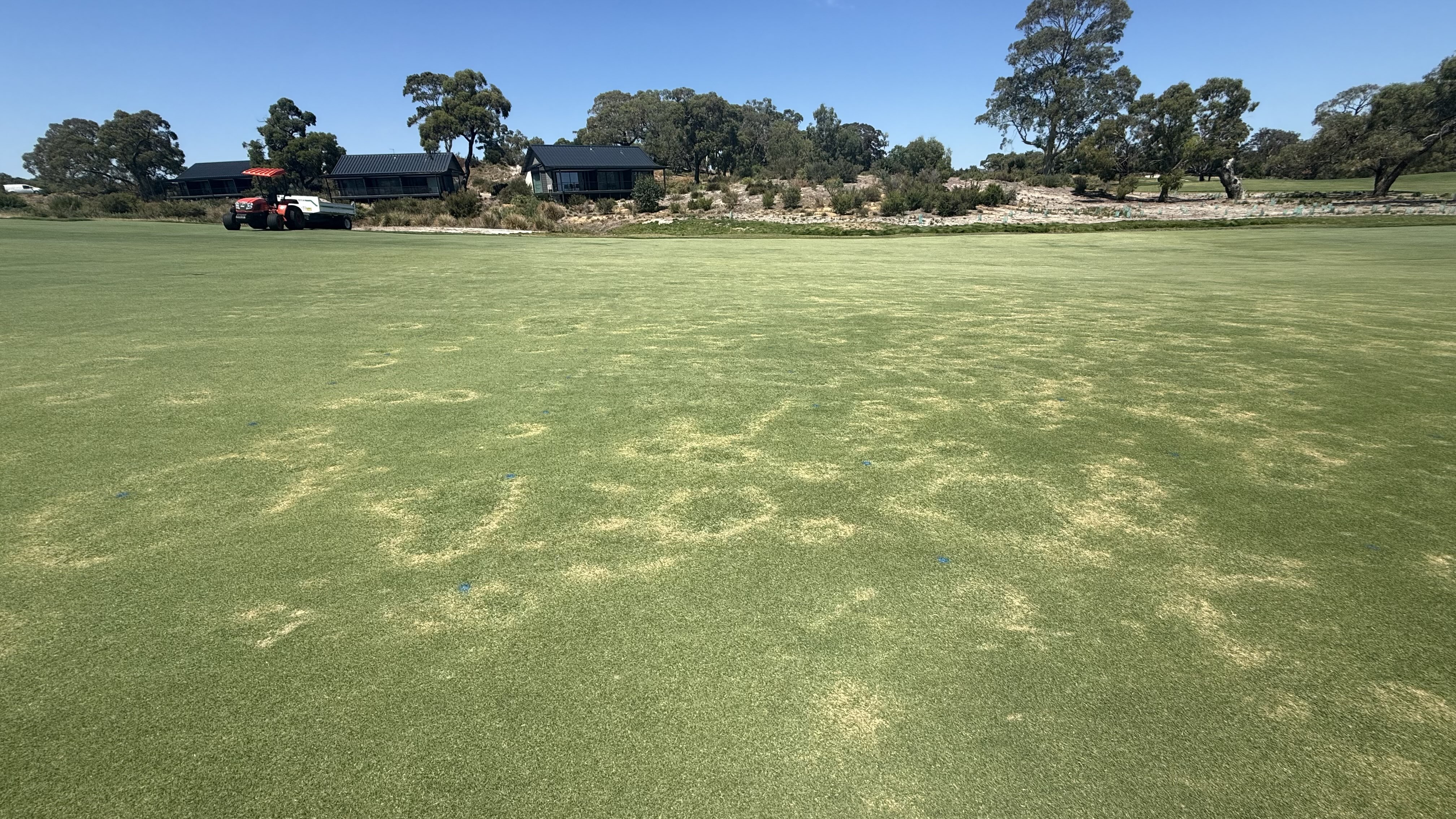
Fairway patch
Phialocephala bamuru
A serious emerging patch disease of warm-season turf first described in Australia, caused by the ectotrophic root-infecting (ERI) fungus Phialocephala bamuru. It has been recorded on couch (bermudagrass) and kikuyu fairways, golf courses and sports fields across multiple Australian states (QLD, NSW, VIC, WA), and there are currently no proven control measures.
Identification
Symptoms begin as small, tan-coloured patches roughly 5-10 cm across that enlarge into brown, often ring-like patches. As they expand the rings can reach up to about 3 m in diameter and coalesce into an irregular patchwork of dead and dying turf. Because it is a root-infecting disease, affected plants show root rot: examine roots for the dark (black) ectotrophic mycelium characteristic of ERI fungi. It can resemble other ERI patch diseases (take-all patch, spring dead spot) and large patch, so laboratory confirmation of Phialocephala bamuru is recommended.
Symptoms
Small tan patches (about 5-10 cm) enlarge into brown, ring-like patches that can reach roughly 3 m across and coalesce into a patchwork of dead and dying turf, most conspicuous on couch and kikuyu fairways.
Signs
Dark (black) ectotrophic mycelium on the surface of roots, stolons and crowns — the hallmark of an ERI fungus — with associated root rot beneath the patches.
Biology
Phialocephala bamuru is a "black sterile" ectotrophic root-infecting (ERI) fungus: it grows as dark runner hyphae over the surface of roots, stolons and crowns, then penetrates and kills root tissue, producing the patch symptoms above. It was described as a new species from Australian turf; much of its life cycle, survival and spread is still being researched.
Epidemiology
An emerging disease of warm-season turf (couch and kikuyu) documented across several Australian states, notably on golf course fairways and sports fields (hence the name). The environmental and management factors that drive outbreaks are not yet well understood, and research into its biology and epidemiology is ongoing.
Favorable Conditions
Not yet well characterised — the disease is newly described and its predisposing conditions are still under study. As a root-infecting pathogen it is expected to be favoured by anything that stresses or weakens the root system.
Cultural Management
No control measures are yet proven for this disease, so management is currently based on general root-health practice: maintain vigorous turf, relieve compaction, manage thatch, avoid drought and nutritional stress, and support root development. These are sensible interim measures rather than validated controls — confirm the diagnosis and follow current Australian (ASTMA / university) advice as research develops.
Further Reading
University extension resources — open in a new tab.
Related Reports
No published reports yet for this pest.
Reports will appear here as they are peer-reviewed and published.