
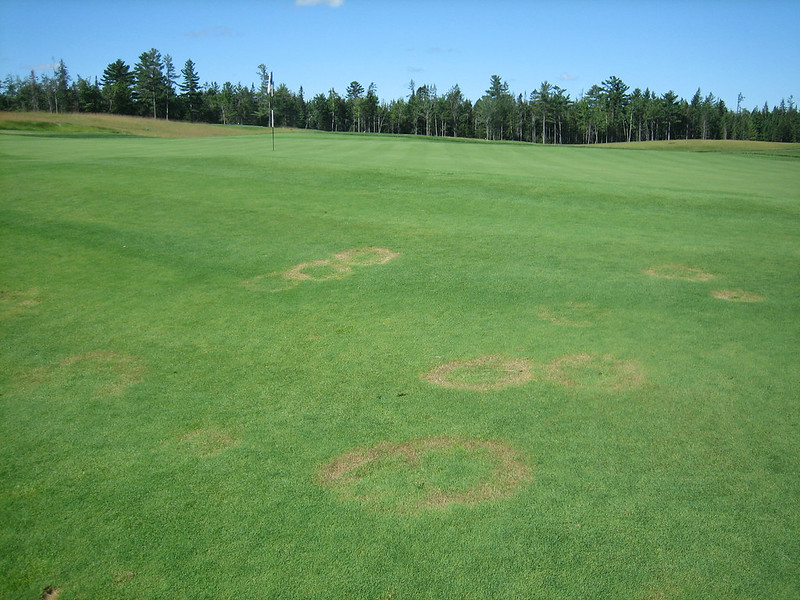
Take-all patch
Gaeumannomyces avenae
A root and crown disease of bentgrass producing reddish-bronze sunken rings, especially on sandy, high-pH sites.
Identification
Circular reddish-bronze depressed patches up to 0.5 m, often with weeds or healthier grass in the center. Dark runner hyphae on roots; rotted, blackened roots.
Symptoms
Take all patch symptoms include distinct patches of turf that appear reddish-brown in color, and wilting within the patch may occur.
Signs
The fungus can be identified by the presence of hyphae on roots and stolons, simple hyphopodia, and discolored vascular tissue.
Biology
Gaeumannomyces graminis var. avenae is a fungus that infects the roots and stolons of turfgrass species, causing take all patch disease. The fungus produces simple hyphopodia, discolored vascular tissue, and no mycelium. The fungus reproduces via spores produced on the hyphae.
Epidemiology
Take all patch is most prevalent on new sand-based greens, and newly deforested CBG fairways. The pathogen is generally active during the fall to spring seasons, but symptoms often appear during the summer during periods of stress. The disease is most severe in the first 1-3 years after establishment and will decline over time.
Favorable Conditions
High soil pH, sandy soils, cool wet weather; common on newer bentgrass establishments.
Cultural Management
Cultural control measures to manage take all patch include maintaining proper levels of Mn, decreasing pH, monitoring soil P, and syringing patch areas all summer.
Further Reading
University extension resources — open in a new tab.
Related Reports
No published reports yet for this pest.
Reports will appear here as they are peer-reviewed and published.