
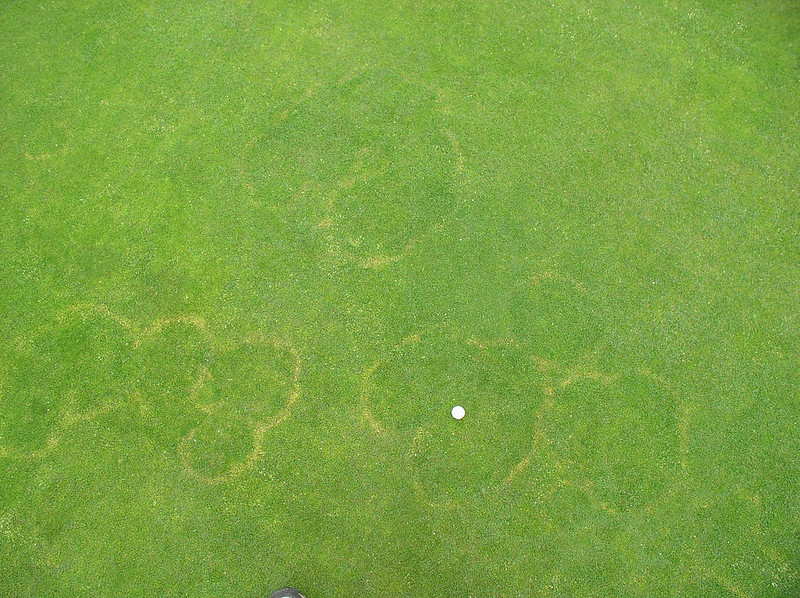
Brown ring patch (Waitea patch)
Waitea circinata (formerly Rhizoctonia circinata)
A Rhizoctonia-like disease of annual bluegrass greens producing yellow-to-bronze rings.
Identification
Yellow then tan-bronze rings and arcs 5-50 cm on Poa annua greens, sometimes resembling yellow patch but active at warmer temperatures.
Symptoms
Brown ring patch appears as circular rings with yellow or orange margins, which can range in size from several inches to several feet. The leaf tissue may appear water-soaked, and under severe conditions, the patch may become sunken or depressed. There is often a darker green center in the affected area.
Signs
Brown ring patch is characterized by profuse mycelium, which can be seen under the right conditions. The mycelium has the characteristic right-angle branching of Rhizoctonia pathogens. Orange, oblong sclerotia may also be present.
Biology
Waitea circinata is a foliar pathogen that infects the crown and leaves of turfgrass plants. It spreads by aerial mycelium which can be observed following incubation of infected plants. It can also produce sclerotia, which are hard, orange, oblong structures that can survive in the soil for long periods of time.
Epidemiology
Brown ring patch is most prevalent on annual bluegrass and is typically seen in the spring and early summer when temperatures are between 77-86F. It is often found after yellow patch and before brown patch, as it relates to the Rhizoctonia pathogens.
Favorable Conditions
Mild temperatures (15-25 C), high thatch and moisture on annual bluegrass greens.
Cultural Management
Cultural control measures for brown ring patch include spoon feeding with nitrogen and a plant growth regulator, such as Primo. However, Primo applied alone may increase the disease.
Further Reading
University extension resources — open in a new tab.
Related Reports
No published reports yet for this pest.
Reports will appear here as they are peer-reviewed and published.