Thatch collapse (Sphaerobolus)
Sphaerobolus stellatus
A thatch-degrading fungus (artillery/cannon fungus) associated with localized thatch collapse and depressions.
Identification
Sunken depressions where thatch has decomposed, sometimes with tiny orange-brown fruiting bodies (peridioles) that shoot spore masses onto surfaces.
Symptoms
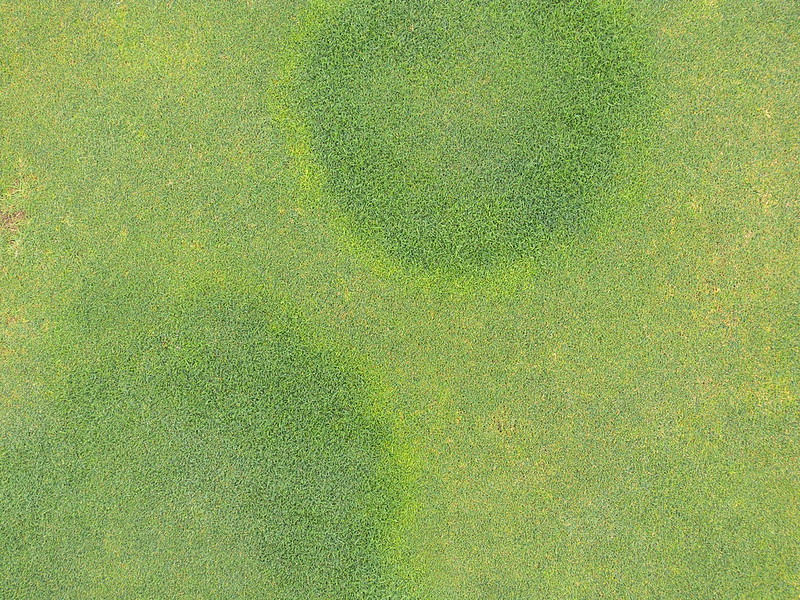
In both cool- and warm-season grasses, symptoms include depressed or sunken patches of dark-green turf ranging from 3-18 in. (8-46 cm) or more in diameter. A yellow ring may be present at the outer edge of active patches. Although the disease does not kill affected turfgrasses, surfaces become sunken and negatively impact uniformity, firmness, and playability of golf course turf.
Signs
Basidiocarps (fruiting bodies) occasionally form near the crown of affected turfgrasses and may extend down into the thatch. Mycelia, with clamp connections, can be found growing through the profile of affected areas. The profile of affected areas often has a mushroom-like smell.
Biology
Sphaerobolus stellatus is a wood-rot fungus often associated with mulch commonly used in home landscapes. Optimum temperature for growth of the organism is 70F. Occasionally found in nature, basidiocarps are white (immature) to creamy-orange (mature) in color and measure 1-3 mm in diameter. When mature, sticky spore masses (glebae) within basidiocarps can be forcefully ejected up to 20 ft.
Epidemiology
Thatch collapse is most severe in heavily thatched turf. Optimum temperatures for the growth of S. stellatus range from 70-86F, but the fungus can grow at temperatures as low as 41°F. Depending on location, symptoms may appear all year long but are generally more severe from late-Spring to early-Autumn. Disease is favored by extended dry periods followed by heavy rains or periodic wet/dry cycles. Since glebae can be forcefully discharged several meters from an individual infection center, they likely play a significant role in the spread of the disease.
Favorable Conditions
Thick organic thatch layers kept consistently moist; rich organic mulches nearby.
Cultural Management
Cultural recommendations include core cultivation to minimize the buildup of organic matter, the application of nitrogen to mask symptoms and the judicial application of sand topdressing to smooth the surface of sunken patches.
Further Reading
University extension resources — open in a new tab.
Related Reports
No published reports yet for this pest.
Reports will appear here as they are peer-reviewed and published.