
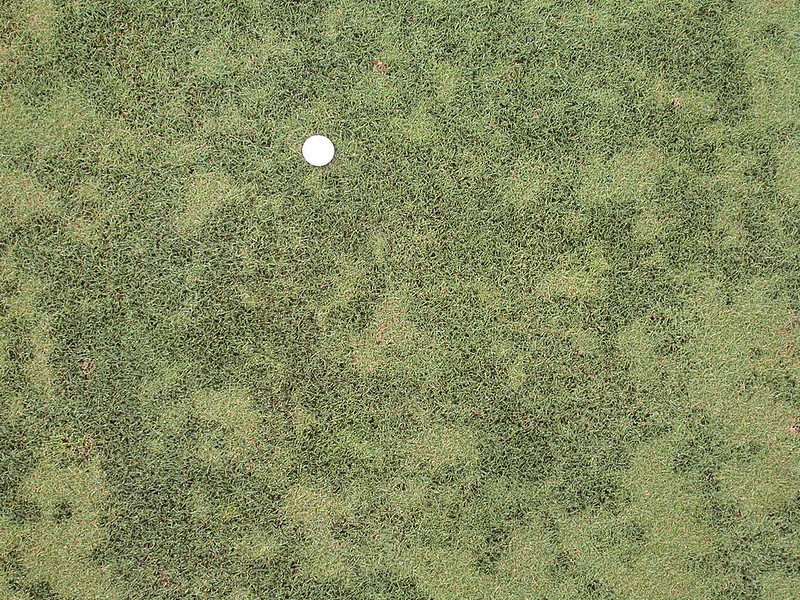
Algae
Oscillatoria spp./Phormidium spp.
Blue/green algae (cyanobacteria) form slimy black crusts and thinning patches on wet, thin putting-green turf.
Identification
Slimy, black crust on the surface of thinned, wet areas, with small circular patches of thinning or yellowing turf.
Symptoms
The symptoms of blue/green algae on putting greens include the appearance of small, circular patches of thinning or yellowing turf. These patches can range from the size of a tennis ball to several inches in diameter. The affected areas may also have a slimy, black crust on the surface. These symptoms can be severe and can lead to general thinning or even death of the turfgrass in the affected areas.
Signs
The signs of blue/green algae on putting greens include the presence of black mucilage, which helps the algae survive under dry conditions, and a slimy, black crust on the surface of the affected area. Additionally, the algae may be visible as individual cells or filaments called "trichomes" which are arranged in a filamentous form and are photosynthetic organisms without a vascular system.
Biology
Algae are photosynthesizing organisms that lack a vascular system. Blue/green algae contain chlorophyll A and phycobilin pigments and the cyanobacteria produce individual cells, typically 1-3 x 1-40 um. These cells are arranged in filaments called "trichomes." Heterocytes algae fix atmospheric nitrogen or akinetes; and cyanobacteria, such as Oscillatoria spp., have "gliding" motility.
Epidemiology
The ideal conditions for blue-green algae to thrive include overcast weather, excessive moisture, exposed soil, mechanical stress or thin areas, and high levels of phosphorous.
Favorable Conditions
The ideal conditions for blue-green algae to thrive include overcast weather, excessive moisture, exposed soil, mechanical stress or thin areas, and high levels of phosphorous.
Cultural Management
Control measures include drying out greens, improving soil drainage and aeration, applying ammonium sulfate to acidify the soil, spiking or verticutting, avoiding overirrigation and lime use, maintaining proper nutritional levels, and increasing mowing height.
Further Reading
University extension resources — open in a new tab.
Related Reports
No published reports yet for this pest.
Reports will appear here as they are peer-reviewed and published.