
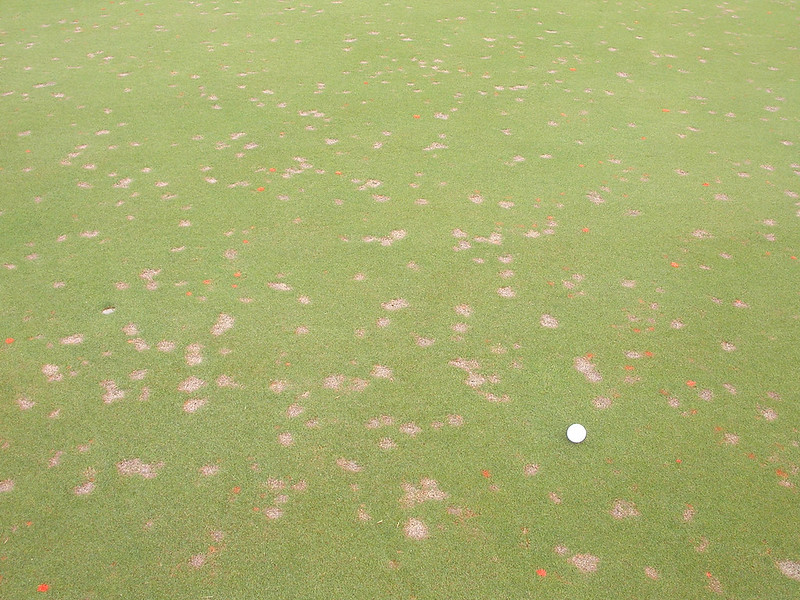
Bentgrass dead spot
Ophiosphaerella agrostidis
A patch disease primarily of young creeping bentgrass greens, producing small reddish, sunken spots.
Identification
Small (1-5 cm) reddish-brown to copper sunken spots, often on greens 1-5 years old. Spots can persist and are slow to recover. Tiny black pseudothecia may form in dead tissue.
Symptoms
Small, reddish brown/copper-colored spots approximately an inch in diameter. These spots can enlarge up to 3 inches and rarely coalesce. When severe center of a spot turns tan and the outer edge of individual spots will appear reddish brown. Spots are slow to heal and may take up to a year to recover.
Signs
Mycelium is sparse and may only be seen under a microscope. Unlike most patch diseases, however, O. agrostidis frequently produces pear-shaped sexual fruiting bodies known as pseudothecia. Ascospores within these fruiting bodies are twisted within individual asci. Spores serve as the primary mechanism for subsequent infections.
Biology
The fungal pathogen likely originates from seed and causes disease symptoms in the first year or two on new putting greens. Shortly after symptoms appear, the fungus can produce sexual fruiting bodies known as pseudothecia that contain copious ascospores. These spores reach maturity in approximately 12 days and are forcefully discharged from the fruiting body and can infect nearby plants.
Epidemiology
Active when temperatures reach or exceed 68°F, optimum for the growth 77-86°F, severe during hot, dry periods in the summer, severe in full sun (prone to heat) and drought stress, less severe in higher-cut collars and tees. The disease generally appears on new, sand-based greens that are less than 6 years old.
Favorable Conditions
High temperatures and high light, sandy rootzones, low fertility and high pH on young greens.
Cultural Management
Affected areas should be plugged out and discarded. Ammonium sulfate source should be used as the primary nitrogen for the first few years when growing in new greens.
Further Reading
University extension resources — open in a new tab.
Related Reports
No published reports yet for this pest.
Reports will appear here as they are peer-reviewed and published.