
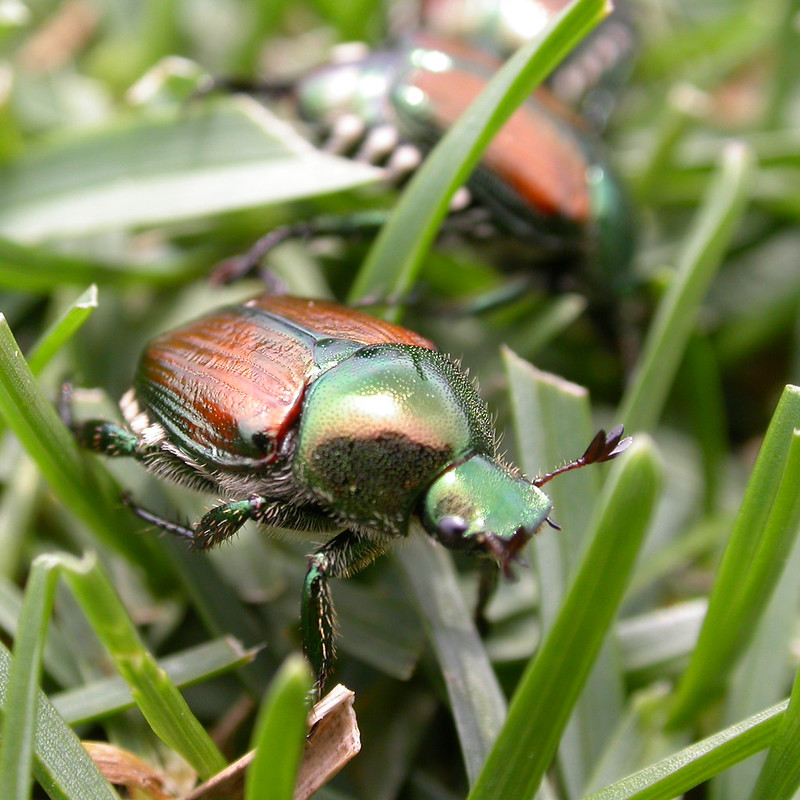
Japanese beetle
Popillia japonica
A metallic-green scarab whose adults skeletonize foliage and whose root-feeding larvae are turf-damaging white grubs.
Identification
Adult Japanese beetles are about three-eighths to one-half inch long with a bright metallic-green head and thorax and coppery-bronze wing covers. The diagnostic feature is five small tufts of white hairs along each side of the abdomen plus a pair at the tip, visible from above and separating it from look-alike scarabs. Adults are day-active and cluster on host plants. The larvae are typical white grubs — C-shaped, cream-colored, with a tan head and three pairs of legs — living at the soil-thatch interface and identified to species by the V-shaped raster pattern of bristles on the underside of the abdomen tip.
Symptoms & Damage
In turf the damaging stage is the larva (a white grub), which chews roots and produces irregular patches of wilting, yellowing turf that brown and can be rolled back like loose carpet; skunks, raccoons, and birds tear up the weakened sod digging for grubs. The adults rarely injure turf directly but skeletonize the leaves of nearby ornamentals, roses, lindens, and other plants, leaving lacy foliage, and heavy adult flights over turf signal the egg-laying that produces the next damaging grub generation.
Biology
Japanese beetle has a one-year life cycle. Adults emerge from turf in early-to-midsummer (about late June through August), feed on foliage, and females lay eggs in moist turf. Eggs hatch in mid-to-late summer and grubs feed on roots through three instars into autumn, then burrow deeper to overwinter, return to feed briefly in spring, pupate in late spring, and emerge as adults the following summer. There is a single generation per year and reproduction is by egg.
Occurrence & Spread
Egg-laying and grub survival are favored by moist soil, so well-watered, sunny turf in mid-to-late summer is especially attractive and at risk. Root damage is heaviest in late summer and early fall when large third-instar grubs feed near the surface, and again to a lesser degree in spring. Adults are strong fliers that aggregate on host plants, so infestations build quickly where irrigated turf adjoins ornamental plantings; injury often appears first on sunny, drought-prone slopes.
Favorable Conditions
Moist, irrigated, sunny turf during the mid-summer egg-laying period.
Cultural Management
Maintain dense, deep-rooted turf that tolerates low grub numbers, avoid keeping soil continuously moist during the peak mid-summer egg-laying window, use endophytic or more tolerant grasses where adapted, and conserve natural enemies; entomopathogenic nematodes and milky spore (Paenibacillus popilliae) are biological options against the grub stage. Hand-removal of adults gives limited turf benefit, and pheromone traps often draw in more beetles than they remove, so they are not recommended for protecting turf.
Further Reading
University extension resources — open in a new tab.
Related Reports
No published reports yet for this pest.
Reports will appear here as they are peer-reviewed and published.