
Turfgrass Insect Library
Reference profiles for turfgrass insect pests — identification, biology, damage symptoms, and management strategies.
Reference only. Always consult current product labels before making insecticide applications. Contact your state extension service or a licensed applicator for site-specific guidance.
21 insects
Annual bluegrass weevil
Listronotus maculicollis
A devastating pest of annual bluegrass on golf courses, with larvae feeding in stems and crowns.
Ants & imported fire ants
Solenopsis spp. and other Formicidae
Social insects that nest in turf; mounding disrupts the surface and can bury/desiccate turf, while imported fire ants also sting people.
Armyworms & cutworms
Spodoptera spp. / Agrotis spp.
Caterpillars that chew foliage, sometimes overnight, leaving notched leaves and circular dead spots.
Bermudagrass mite
Aceria cynodoniensis
A microscopic eriophyid mite that causes tufted, witches-broom growth on bermudagrass.
Billbugs
Sphenophorus spp.
Weevils whose larvae bore in stems then feed on crowns/roots, causing drought-like dead patches.
Black turfgrass ataenius
Ataenius spretulus
A small scarab whose grubs damage golf course fairways, tees, and greens; overwinters as an adult and feeds earlier than other white grubs.
Chinch bugs
Blissus spp.
Sap-feeding bugs that inject toxins, causing expanding patches of yellow then dead turf in sunny, dry areas.
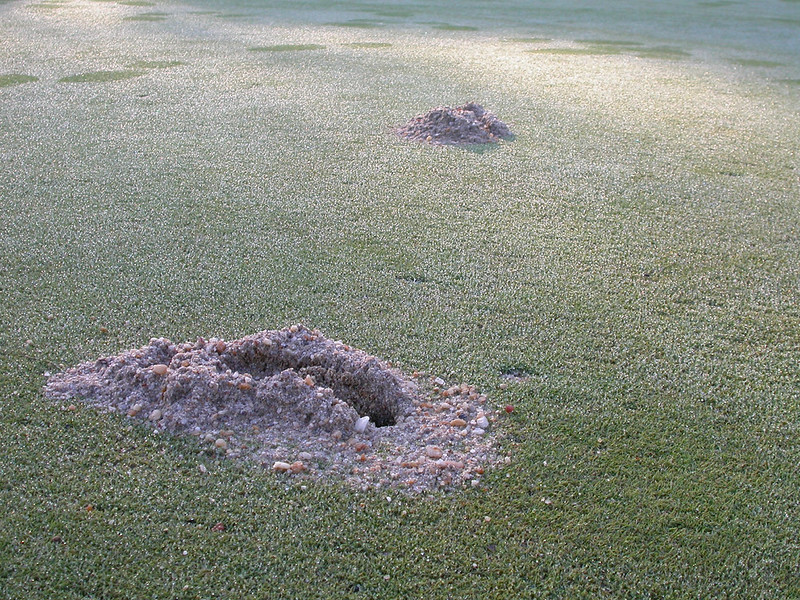
Cicada killer wasp
Sphecius speciosus
A large solitary digging wasp whose burrowing females push up soil mounds in thin, sandy, sunny turf.
Earthworm castings
Lumbricidae (e.g., Lumbricus terrestris, Aporrectodea spp.)
Soil-dwelling earthworms are beneficial below ground but deposit muddy surface mounds (casts) that disrupt closely mown, high-value turf.
European crane fly
Tipula spp.
Larvae (leatherjackets) feed on roots and crowns, thinning turf in cool, wet regions.
Greenbug aphid
Schizaphis graminum
A sap-feeding aphid that injects toxins, causing burnt-orange patches especially in shade.
Ground pearls
Margarodes / Eumargarodes spp.
Tiny root-feeding scale insects of warm-season turf (especially centipedegrass); nymphs encase themselves in pearl-like cysts and are very hard to control.
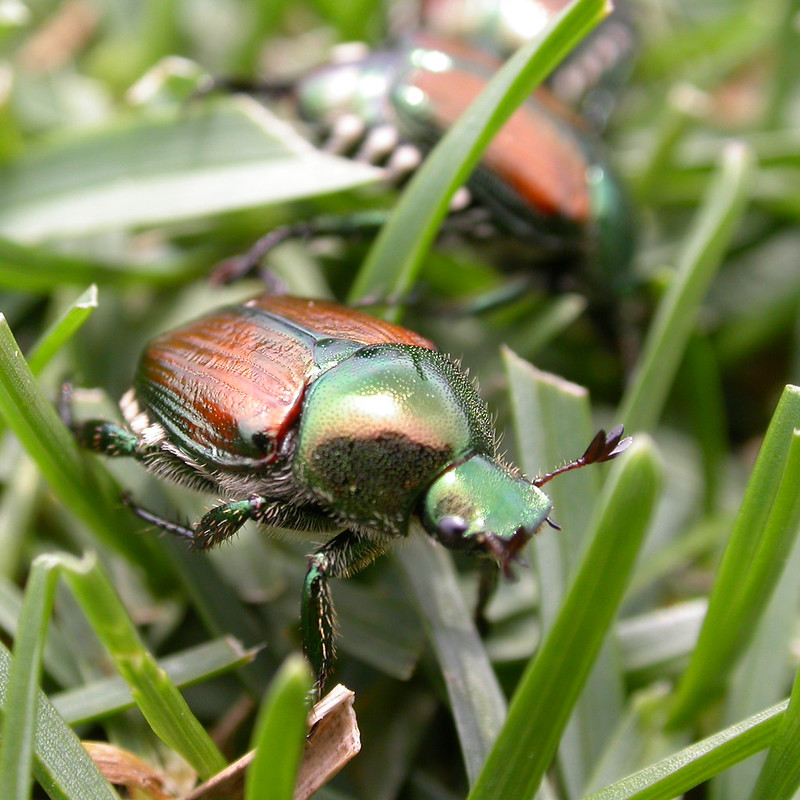
Japanese beetle
Popillia japonica
A metallic-green scarab whose adults skeletonize foliage and whose root-feeding larvae are turf-damaging white grubs.
Leafhoppers
Cicadellidae
Small piercing-sucking insects that remove plant sap; usually minor but heavy populations whiten and thin turf, especially new seedings.
Mole crickets
Neoscapteriscus spp.
Burrowing crickets that tunnel through the root zone, uprooting turf and creating spongy soil.
Periodical cicadas
Magicicada spp.
Large insects whose nymphs feed on tree roots for 13–17 years; emergence holes can riddle turf, especially under trees.
Scale insects & mealybugs
Antonina graminis (rhodesgrass mealybug), Odonaspis ruthae (bermudagrass scale)
Sap-feeding scale insects and mealybugs of warm-season turf; the rhodesgrass mealybug can wither and kill bermudagrass and St. Augustinegrass.
Sod webworms
Crambus and Parapediasia spp.
Larvae of small lawn moths that chew leaves at night, creating ragged brown patches.
Two-lined spittlebug
Prosapia bicincta
Sap-feeders whose nymphs hide in frothy spittle; heavy feeding yellows centipede and bermudagrass.
White grubs
Scarabaeidae (e.g., Popillia japonica, Cyclocephala spp.)
Root-feeding scarab larvae that cause wilting and patches of turf that pull up like carpet.
Wireworms
Elateridae (click beetle larvae)
Hard, cylindrical, wire-like larvae of click beetles that chew turfgrass roots; damage is usually minor unless populations are large.