
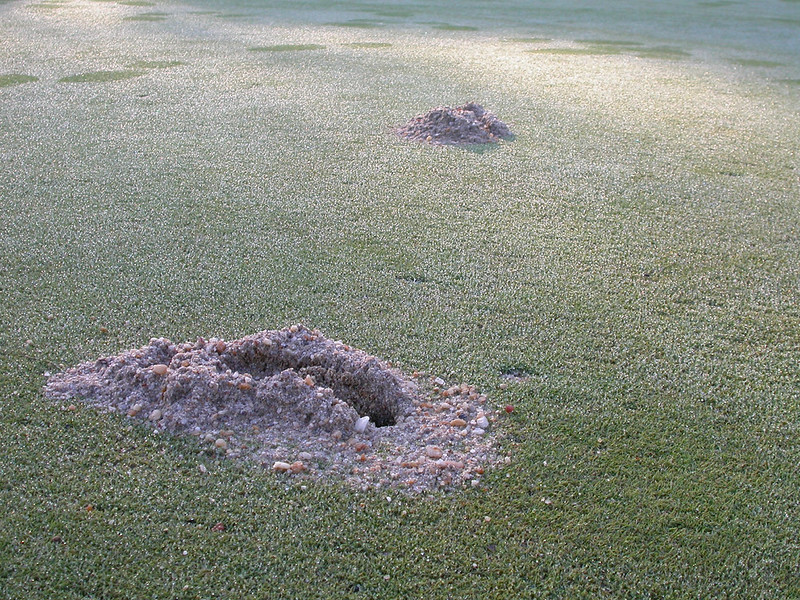
Cicada killer wasp
Sphecius speciosus
A large solitary digging wasp whose burrowing females push up soil mounds in thin, sandy, sunny turf.
Identification
One of the largest wasps in North America, roughly one to one-and-a-half inches or more long, with a black-to-reddish body marked by pale yellow bands along the abdomen, rusty-red legs, and amber-tinted wings. They resemble giant hornets but are solitary rather than colonial. The clearest turf signs are the burrows: females excavate tunnels in the soil and leave a mound or fan of loose soil beside a roughly finger-sized entrance hole, typically on slopes, bunker faces, tees, and sparse sunny lawns, while large adults patrol low over the turf.
Symptoms & Damage
The damage is cosmetic and physical rather than to the grass itself: burrowing females push up conspicuous mounds and fans of soil that smother and disfigure turf, dull mower blades, and leave a pockmarked surface on tees, slopes, bunker faces, and thin lawns, and many individual burrows in a favorable sunny, sandy area can riddle the surface. The wasps are also a nuisance because their large size and low patrolling flight alarm golfers and homeowners, though the territorial males cannot sting and females sting only if handled.
Biology
Cicada killers are solitary wasps with one generation per year. Adults emerge in mid-summer (roughly July into August), coinciding with cicada activity; each female digs her own burrow in bare or thin sunny turf, hunts and paralyzes cicadas, and stocks the burrow cells with them before laying an egg on each. Larvae feed on the provisioned cicadas, overwinter in the burrow as prepupae, pupate in spring, and emerge as the next summer's adults. Because each female nests alone, an apparent infestation is many independent burrows clustered in the same favorable soil rather than a true colony.
Occurrence & Spread
The wasps select and re-colonize the same open, sunny, well-drained, sparsely vegetated soils year after year — south-facing slopes, bunker faces, tees, edge gaps, and drought-thinned lawns — because bare soil and warmth make digging easy. Dense, vigorously growing turf is largely avoided, so problems concentrate exactly where turf cover is already weak; loose or sandy soils and full-sun exposure are the strongest drivers of nesting.
Favorable Conditions
Thin, dry, sandy or bare turf in full sun; slopes and well-drained banks.
Cultural Management
The most durable control is to thicken the turf: fertilize, irrigate, and overseed thin, dry, sunny areas so a dense canopy denies the wasps the bare, warm soil they need to dig, since they largely avoid well-covered ground. Improving turf density on slopes and bunker faces, adding ground covers or mulch on chronically bare banks, and tolerating the short mid-summer flight period — the wasps are beneficial cicada predators that disappear by late summer — are the key non-chemical tactics.
Further Reading
University extension resources — open in a new tab.
Related Reports
No published reports yet for this pest.
Reports will appear here as they are peer-reviewed and published.